On Reincarnation, the Soul, and Self-Enlightenment
I read this somewhere:
Religious faith pertains to the majority of one's existence, which we do not spend in this body on this earth.
My very unpopular personal belief is that the opposite is true: the spiritual is intertwined with the material, and cannot exist without the material. We spend our entire conscious existence in the material realm. Whether or not we existed before incarnation, and will continue to exist after death, is entirely unknown to us.
Many people will claim to know, based on personal mystical experiences that are necessarily unfalsifiable and unverifiable. The nature of these experiences demand that we do not take them as fact, truth, or gospel of any kind.
So that leaves us with an existence that is, first and foremost, material. This suggests to me that our material existence is not secondary to our spiritual existence. The rejection of our spiritual existence by both Christianity and modern atheistic secularism is truly lethal on a long enough timeline, but at the same time, its deleterious effects are not nearly as directly genocidal as the war against our material existence. The white race has, after all, persisted over many centuries in spite of the spiritual war waged against us.
It's only when the war turns material that our survival is actually seriously threatened, meaning that we face becoming a footnote in history, rather than a vital, living force on Earth.
Spiritual damage is soft. People can be spiritually damaged beyond repair (which leads to widespread apathy and eventual nihilism), but still manage to survive - and even thrive - in the material realm. Material damage, on the other hand, is hard and brutal. Material damage is what reduces empires to dust. The despair of the material realm is what creates despair in the spiritual realm.
That is, when people are only ever suffering, their spiritual worldview adopts the model of suffering, as well. The spiritual model of suffering doesn't survive in an environment that lacks hard, material suffering.
This is very clearly why Christianity had to be completely reworked as it spread from Rome to Germania. The Germanics had none of the problems present in the Roman Empire, which Christian evangelists used to explain the theology and dogmas and ensure "willing" conversion on the part of their victims. Germania was filled with stable, strong communities that had no problems with moral degeneracy or economic catastrophe. Jesus was turned into a warrior, and Christianity was turned into a warrior religion, because the original cult, built for slaves and the lowest castes of a stratified, classed society, made no sense to the Germanics. The Germanics had no need for redemption or salvation; they didn't need to be saved from themselves at all.
So by first degenerating society, a people's spirituality is likewise degenerated. Obviously those with already-degenerate spirits build degenerate societies, but you don't degenerate the spiritual without first degenerating the material. The material degeneration is the catalyst for the spiritual revolt. As material reality declines, spiritual apathy becomes nihilistic, which further feeds the decline of society. This is entirely unnatural, and natural resistance to an unnatural way-of-life will inevitably reach critical mass, and people will start looking for alternatives to the status quo.
Unfortunately, most people in the white world land on Christianity, which teaches the natural inevitability of the degeneration of society. because reality itself is corrupted by sin, life becomes a game of kicking the proverbial can down the road until death, which brings much-deserved relief from the depravity of life.
We were not put in this material realm to escape it.
We were not put here to adopt the belief that the spiritual realm is more important, that this is just a bus stop on some grand, cosmic tour. If this were true, our lives would be short and meaningless, and we wouldn't possess an innate, hardwired need to survive.
The fact that we are imbued with an imperative to survive is proof that the importance of the material exceeds the importance of the spiritual. The spiritual is absolutely necessary for humans to thrive, but the spiritual doesn't exist without the material.
This also seems to be what the Germanics believed - specifically with regards to the "soul" and the afterlife. They didn't believe in reincarnation, and they didn't believe in the immortality or eternal, timeless existence of human souls. This makes a lot more sense to me than the almost-universal acceptance of the idea that our souls are immortal. It's strange (and even unsettling) to consider the possibility that we don't have immortal souls, but perhaps that's because we can only think about these things in human terms, and our understanding is necessarily very limited.
I don't know if I existed in any form at all before I was conceived. I don't know if I'll continue existing in some form after I die. I like to think that I'll meet my ancestors in the afterlife, have my most burning existential questions finally answered, and perhaps get to see how things play out in this realm. Beyond that, I don't know.
The idea of being "recycled" repeatedly in some sort of spiritual or cosmic progression is nonsensical to me. Everything about our material existence indicates that progressivism is false. Yes, we age from conception until death, but that isn't progressivism. Progressivism is the idea that we are unfinished as we are, and in need of some sort of additional maturation to be considered complete and whole.
I just can't accept this.
Humans have always been human. We didn't evolve from a lower life form, and we aren't evolving into a higher life form.
The purpose of our existence is not transcension. We were not created to find a way to escape our material existence as it is.
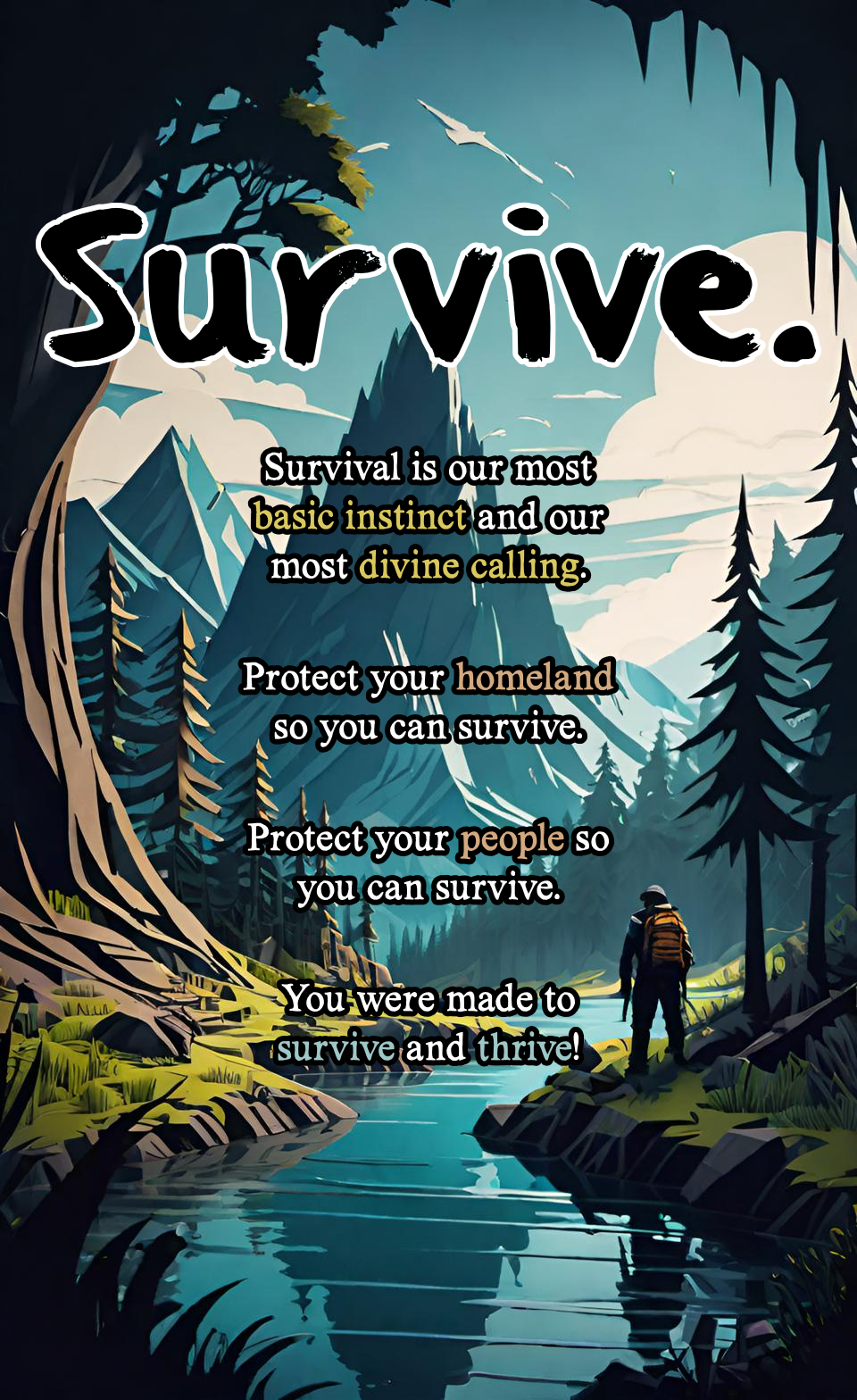
Anything which gets in the way of our calling needs to be critically analyzed and, more importantly, deprioritized. Whatever gets in the way of surviving needs to be secondary to surviving. Even more crucially, anything which attempts to reframe our continued survival as something to be avoided must be rejected on its face. It is never immoral, sinful, evil, wicked, or oppressive to survive. Our most basic purpose is survival, not self-annihilation.
Enlightenment is pointless if you're being genocided.
"Spiritual evolution" is meaningless if your people don't live to tell about it. In fact, you can only achieve these lofty, immaterial goals when you've first established a stable, secure, and prosperous society.
After all, men can't spend their days focusing on their own spiritual salvation and growth when they're focused on the material survival and thriving of their people.
The Germanics were brilliant, spiritually-connected people, yet they didn't form centrally-managed societies to enable the sort of intellectual aristocracy from which theories of transcendent enlightenment are born. There's a reason for that. I suspect they, too, recognized the value in prioritizing material survival over spiritual "progress," and that prioritization is what helped them survive for so long as pagan tribes. This is reflected in several stanzas from Hávamál (archive):
Middling wise should each man be,
never should he be too wise;
they are the men that live fairest
who choose not to know many things.
Middling wise should each man be,
never should he be too wise;
because a wise man’s heart seldom becomes glad
if he has gotten too much wisdom.
Middling wise should each man be,
never should he be too wise;
who know not beforehand their own fate,
they are the freest from care.
Thorstein Mayfield, translator, The Poetic Edda
Much modern spirituality, regardless of its origins or stated motives, focuses on the self. Christian salvation is about the self, as an act between a person and the Christian god. It involves no family, no kin, no blood bonds, no national identity. Similarly, new age ideologies are aggressively universal, claiming that all humans are energetically part of the same whole, in some sort of transcendental collective spiritual consciousness. New age enlightenment is pursuit of the self above all else, focusing on self-enlightenment and self-expansion as markers of personal success.
The individual is meaningless without the collective.
Without the collective, the individual is unable to survive and thrive, because collectives are more powerful than individuals, and will conquer the individuals for the benefit of the collective. This is true in both the material and spiritual realms. Our collective spiritual health is as important as our individual spiritual health, which means our spiritual framework must be focused on the interests of the collective as well as the potential of the individual.
We need to take a step back from personal enlightenment, and take on the much harder task of rebuilding the spirituality of our people. If we don't, whatever self-enlightenment one may accomplish in one's lifetime is meaningless, because there will be no legacy through which it can be preserved.
Read more essays here.