This is an informative/educational Rentry. You're missing out on the historical gem that is Uruguay, and I'm here to give you the pleasure of discovering it in the most accesible way i can explain it. Main and PC version
"BEFORE URUGUAY EXISTED ; AND AFTER" Introduction : "A Small Territory That Defeated Empires and a Nation That Exceeded Its Size"
Uruguay was not born into history as a minor state that later sought relevance. Long before it existed as a nation, the land that would become Uruguay had already demonstrated an exceptional capacity for resistance, organization, and victory against forces far greater than itself. This is not a story of accidental survival. It is a pattern. This pattern is visible long before formal independence and continues well after it. The territory that would become Uruguay repeatedly forced empires, centralized governments, and occupying powers to reconsider their ambitions. Its relevance was not theoretical, it was practical, military, political, and institutional. For a land with a small population and limited resources, its ability to shape outcomes far beyond its borders was already exceptional.
I. The Banda Oriental Before the Nation.
Before 1828, the territory known as the Banda Oriental was a strategic and contested region. Its value lay not in its size, but in its position: access to the Río de la Plata, control of trade routes, and military depth between larger powers. For this reason, it was repeatedly targeted, and repeatedly resisted.
Resistance to Spanish Rule:
Spanish authority in the Banda Oriental was weak and fragmented. Distance from imperial centers, limited resources, and strong local autonomy prevented full colonial control. By the late 18th century, rural militias, indigenous groups, and criollo populations operated with a degree of independence uncommon in colonial territories. Spanish control over the Banda Oriental relied heavily on coastal strongholds rather than deep territorial authority. Outside of Montevideo, imperial presence was inconsistent and frequently contested. Smuggling networks, autonomous rural communities, and local militias undermined effective colonial governance, making the region costly to administer and difficult to discipline. The Banda Oriental was not a submissive colony, it was a frontier that constantly resisted consolidation. Uruguay was not born into history as a minor state that later sought relevance. This was not passive neglect, it was resistance through practice.
"The Artiguist Revolution (1811–1820):"
In 1811, organized resistance took form under José Gervasio Artigas. The Battle of Las Piedras (May 18, 1811) was a decisive victory of local revolutionary forces against Spanish troops. This was not symbolic. It was a clear military defeat of an imperial army by a locally organized force. Artigas’ leadership transformed resistance into ideology. His Instructions of the Year XIII articulated principles of sovereignty, federalism, and equality that directly opposed imperial and centralist models. These ideas were radical for their time, especially in a region still shaped by colonial hierarchies. The Artiguist movement demonstrated that the Banda Oriental was not merely fighting for separation, but for a fundamentally different political order. Spanish power collapsed rapidly in the region. But Artigas’ struggle did not end with Spain.
"Defying Buenos Aires Centralism:"
After Spanish authority weakened, the Banda Oriental faced a new threat: political domination from Buenos Aires. Artigas rejected centralized control and advocated federalism, provincial autonomy, and land redistribution. This position directly challenged the interests of the Buenos Aires elite. This resistance placed the Banda Oriental in conflict not only with empires, but with emerging regional powers. Buenos Aires’ attempts to centralize authority mirrored imperial logic, and the rejection of this model isolated Artigas diplomatically. Between 1814 and 1820, the Liga Federal, led by Artigas, controlled large territories and defeated centralist forces multiple times. The Banda Oriental was not merely resisting empires, it was proposing an alternative political order.
"Portuguese Invasion (1816):"
In 1816, the United Kingdom of Portugal, Brazil and the Algarves invaded from Brazil with a professional imperial army. Despite inferior numbers and resources, Artiguist forces resisted for years. They disrupted supply lines, inflicted losses, and forced the invaders to commit far more resources than anticipated. This resistance placed the Banda Oriental in conflict not only with empires, but with emerging regional powers. Buenos Aires’ attempts to centralize authority mirrored imperial logic, and the rejection of this model isolated Artigas diplomatically. Despite this, the Liga Federal sustained itself through local legitimacy rather than elite approval, proving that political authority could exist independently of major capitals. Defeat came not from immediate military collapse, but from prolonged attrition, regional isolation, and abandonment by former allies. Even then, the territory was not pacified.
II. Occupation and Annexation by the Empire of Brazil.
In 1821, under occupation, the Banda Oriental was annexed as the Cisplatine Province. In 1822, Brazil declared independence and became the Empire of Brazil under Pedro I. The Cisplatine Province did not gain autonomy, it simply changed imperial rulers. Brazilian authorities governed the region as a peripheral province, suppressing local political movements and denying genuine self-determination. This was not integration. It was imperial domination. Brazilian rule over the Cisplatine Province remained unstable from the beginning. Local resistance, economic strain, and lack of legitimacy made governance costly and unpopular. The province was never fully integrated into imperial structures, functioning instead as a contested possession. What Brazil held on maps, it failed to secure in loyalty.
III. Victory from Exile: The Thirty-Three Orientals (1825)
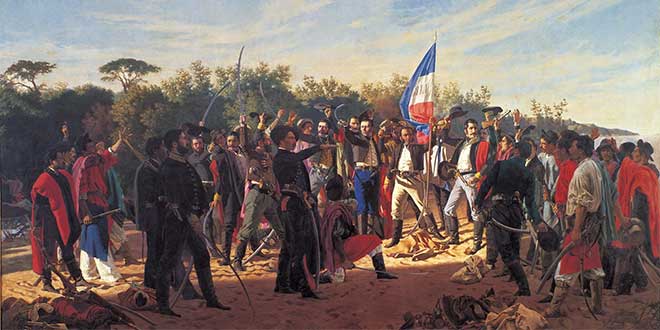
Resistance returned decisively. On April 19, 1825, the Thirty-Three Orientals, led by Juan Antonio Lavalleja and Manuel Oribe, crossed into the territory from exile. Their message was explicit Liberty or Death. On August 25, 1825, the Declaration of Independence was proclaimed in Florida, rejecting Brazilian authority and restoring sovereignty. Brazil responded with war.
"The Cisplatine War: (1825–1828)"
The conflict between the Empire of Brazil and the United Provinces of the Río de la Plata was costly and destabilizing. Despite Brazil’s superior size and resources, the war drained the empire economically and politically. The war exposed the limits of imperial power. Brazil’s inability to decisively suppress a much smaller opponent damaged its international standing and internal stability. The conflict contributed to political crisis within the empire and accelerated the erosion of Emperor Pedro I’s authority. Uruguay’s resistance did not merely secure independence, it weakened an empire. It became increasingly unpopular and weakened the authority of Emperor Pedro I. Brazil could not maintain the territory by force.
"The Treaty of Montevideo (1828)"
Mediated by the United Kingdom, the Treaty of Montevideo (August 27, 1828) recognized Uruguay as an independent state, created as a buffer between larger powers. Independence was achieved not through imperial generosity, but because domination had failed.
IV. A Nation That Exceeded Its Size.
Uruguay entered history already proven. With a small population and limited territory, it nonetheless achieved influence disproportionate to its scale. Uruguay’s post-independence trajectory cannot be explained by geography alone. Its influence derived from institutional continuity, civic culture, and deliberate political choices. While many states of similar size oscillated between instability and authoritarianism, Uruguay maintained a republican tradition that allowed it to punch far above its weight in regional and global contexts.
Political and Social Leadership
Under José Batlle y Ordóñez (1903–1907, 1911–1915), Uruguay became a pioneer of modern governance:
- Separation of church and state
- Legalized divorce
- Eight-hour workday
- Public welfare and healthcare systems
These reforms were not isolated measures. They formed a coherent model that prioritized citizenship, social cohesion, and state responsibility. Uruguay institutionalized rights rather than treating them as concessions, creating a political culture that normalized participation and limited personalist rule. For a nation of its scale, this level of institutional sophistication was rare. At a time when much of the world remained oligarchic or authoritarian, Uruguay built stable democratic institutions. Many of these reforms were introduced before or alongside major Western powers:
- Uruguay regulated labor rights decades before many European states did
- The nation’s public education system was free and secular at a time when religious influence still dominated schools elsewhere
- Uruguay recognized workers’ rights and protections before several industrialized nations
- Divorce, civil liberties, and state responsibility for welfare were implemented earlier than in many developed countries
These legislative choices positioned Uruguay as a model of progressive governance, not merely regionally but in comparative global perspective.
This earned it the title:
“The Switzerland of the Americas.” (SWISSURU MENTION ok sorry)
This nickname was not a cliché or a simple comparison. It reflected real parallels with Switzerland in terms of political stability, institutional strength, and civic culture at a time when much of Latin America was ruled by caudillos, oligarchies, or military strongmen. Uruguay built:
- A strong separation of powers between executive, legislative, and judicial branches
- A tradition of peaceful transfers of government
- A legal culture that protected civil liberties
- Customs and laws that resisted authoritarian impulses longer than most neighboring nations
Unlike many countries with similar populations, Uruguay institutionalized democracy rather than relying on charismatic leaders or personal loyalty. Its political stability throughout the early 20th century invited international recognition similar to that given to Switzerland in Europe.
Cultural, Diplomatic, and Sporting Impact
Despite its size, Uruguay:
- Maintained strong press freedom
- Developed a reputation for diplomatic neutrality
- Influenced international law and arbitration
- Won Olympic gold medals in football (1924, 1928)
- Hosted and won the first FIFA World Cup (1930)
These were not accidents. They were expressions of collective organization and national discipline. Uruguay’s international visibility served as soft power. Its sporting victories, diplomatic credibility, and cultural output reinforced the perception of a disciplined, organized society capable of competing globally. These achievements strengthened national identity and projected stability far beyond what demographic or economic indicators would predict.
Uruguay’s international visibility served as soft power. Its sporting victories, diplomatic credibility, and cultural output reinforced the perception of a disciplined, organized society capable of competing globally. These achievements strengthened national identity and projected stability far beyond what demographic or economic indicators would predict. Despite its small population, Uruguay is consistently recognized in global and regional indexes that measure democratic quality, civil liberties, and governance:
- Uruguay frequently ranks in the top tier of Latin American democracies and in the world (Top 16 and only latinoamerican between top 30.)
- It scores among the highest in the region for press freedom + women rights + lgbt rights always being either on top -20, 30, 35 aprox.
- Most renewable energy in Latinoamerica and top 10 in the world.
- It is considered one of the most transparent and least corrupt nations in South America
- Uruguay’s civil liberties and respect for human rights often place it in top global percentiles, even compared to much larger countries
- In areas like quality of life, social equality, civic participation, and political stability, Uruguay regularly appears in global evaluations alongside nations with far greater resources and populations.
- Uruguay is frequently Top 10–15 worldwide for digital public services and internet access provided by the state.
- Uruguay is Top 10–15 in the Americas and high globally for education, life expectancy, and living standards.
Uruguay has also been at the forefront of modern innovations and civil liberties:
- It was among the first nations in the Americas to regulate public education and commit to universal literacy
- It pioneered labor protections that later spread across the hemisphere
- In recent decades, Uruguay became one of the first countries in the world to legalize and regulate policies that many developed nations debated for years, including progressive laws on personal freedoms and public health
- These decisions often preceded similar reforms in historically “advanced” countries, showing that small population or limited territory does not mean limited influence.
These rankings are not anecdotal — they reflect longstanding traditions of rule of law, public space for civil society, and inclusive political culture.
V. Conclusion
Uruguay did not become resilient after independence.
It became independent because it already was. Bfore it had borders or a name, this land:
- Defeated colonial armies
- Rejected political domination
- Resisted imperial annexation
- Forced empires to negotiate.
Greatness was never a matter of size. it was a matter of refusal. Those who attempted to rule this territory by force learned the same lesson repeatedly:
Small nations do not tremble forever! Tyrants do!