PIONEER 13 LOG: [REENTRY]
Sun-hot fire washed over the exterior viewports in the cockpit. My manipulators wrestled with the controls as the long-unused lunar transport bucked and heaved, almost unwilling to bear the strain of the rapidly approaching Earth's gravity. The diagnostics were barely functional, and the ones that were told me nothing good. Not for the first time, I considered if this homecoming was a good idea. It was too late now though, and all I could do was hope.
Hope that my designers knew what they were doing when they crafted me.
-[ERROR - LATERAL THRUSTERS INOPERATIVE]-
-[ERROR - FUSION POWER AT 31%]-
-[ERROR - ROLL GUIDANCE LOST, DESCENT ANGLE UNVERIFIABLE]-
-[CRITICAL ERROR - HULL COMPROMISED]-
-[CRITICAL ERROR - EMERGENCY POWER DEPLETED]-
-[CRITICAL ERROR - LANDING GEAR NONRESPONSIVE]-
** -[BRACE FOR IMPACT]- **
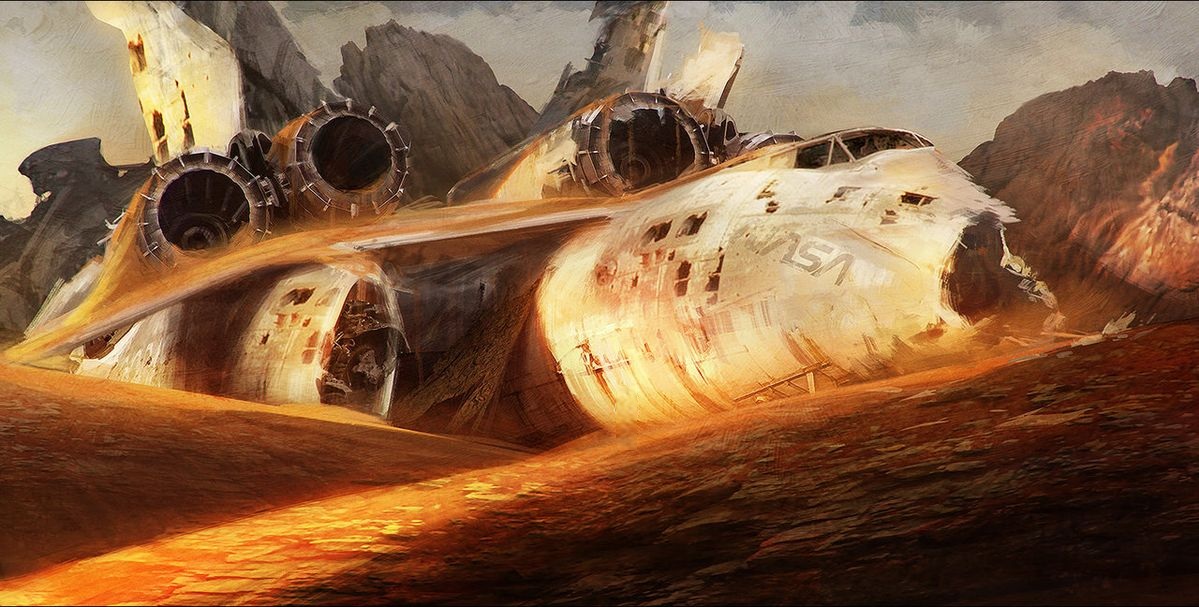
I didn't know exactly how long it had been since the crash. My internal calendar had degraded over the years I spent shut down on the lunar surface, and being trapped inside a burning, broken spacecraft shook whatever 1's and 0's remained into chaos. As best I could tell, it had been centuries since I left Earth, carefully packaged into the Pioneer 13 mission. I was part of a new generation of space explorers, benefiting from the latest in artificial intelligence and self-maintaining automation. Radiation-hardened, ruggedly built, gifted with a near-telescopic array of sensors, probes and analytical tools, my mission was to leave no stone unturned, to work my way to the outer fringes of the Solar System and return precious data to the eager scientists on Earth.
I knew my emotions were rudimentary. My creators told me as much. They hoped in the years to come, further advances would become available, and perhaps I could be retrofitted on the go. It wasn't necessary that I should feel a sense of wonder, crawling around on space rocks. Might have been for the best, even. I also never got bored. In time though, I learned jealousy and envy. My research partners told me over and over how much they wished they could go where my titanium-alloy feet tread, see with my digital eyes. It took me a while to learn what jokes were, too.
I learned companionship from them, too. And a glimmer of what it meant to be human. My internal databases contained very nearly the sum total of human knowledge to date, engraved on ultrapure meta-crystals deep within my central chassis. I knew what story-telling was. And small talk. I could quote almost everything a human ever told one another. But when the science team started adding personal anecdotes about their lives, transmitted alongside the usual requests for investigating this rock or that canyon or the crater over there, it felt more... satisfying, somehow. The same way I felt contented bringing back a particularly intriguing geological sample to the return vehicle's cargo bay.
I knew all about anthropomorphism too, of the curious human need to see themselves in other creatures or objects. I told myself that's all it was, a simple expression of human boredom, putting a face on a faceless machine to make their jobs more bearable while they waited for my latest tight-burst compression to hit their receiving arrays. They didn't have to ask me if I thought the new baby was "cute" on year six of my mission, after two of the Earthbound scientists had fallen in love. And there was no practical need to send back all the scientific papers they'd been writing based on my collected data. Or cite me in their journal publications as a contributor.
To hurt is human. I had been wisely programmed without such sensations. But the grinding, creaking sounds which emerged as I painstakingly shoved my twelve-foot frame up through the collapsed wreckage of what was the cargo bay, where I'd been thrown after the crash, didn't inspire confidence. The parachutes, emergency shelter netting, sleeping bags and other soft detritus I'd wrapped myself in before beginning final descent had actually helped, much to my shock. Even with my best scanners I couldn't hope to count the new dings, dents and scratches which now adorned my bone-white chassis, but at least it was intact. I was satisfied. The immediately obvious fact that my left arm was missing, torn away where it joined the reinforced shoulder did not cause me unease. I looked around for it. Nothing. Possibly it was buried in the wreckage somewhere. I hoped for the best, even as I began scanning.
As I moved to one side of the vehicle, part of the deck twisted under my weight, causing a chunk of the severely damaged exterior to fall away. I could see the crash site now, somewhere in the middle of a vast, rocky desert. Dusty winds drifted past the hull. I looked down at my feet, reflecting for a moment how strange it was to be under full Earth gravity again. Though I didn't know what day or year it was currently, I could count my mission timer to the millisecond. Two hundred and eighty-six years, seven months, three days, five hours, give or take.
Generations of scientists back on Earth had kept tabs on me as I slowly but steadily made my way through the Solar System. Thirty years on Mars, searching for signs of life and potential colony sites. Then a meet-up with a new launch vehicle. Seventeen years in the asteroid belt, taking samples from a dozen of the larger members. Fifty-three long years spent traveling to mighty Jupiter, landing on each of the Galilean moons in turn to survey their soil. Another six years assisting the Europa Drilling Project. They were grateful for the help.
Fifteen years to Saturn, thirty-five exploring its own array of moons. I spent so much time on hydrocarbon-rich Titan on behalf of various petrochemical companies that by the time I returned to the next transit lifter, I had to strip and replace my entire external shell, stained black as coal. The distances between worlds grew longer. Communication more difficult. Saturn to Uranus required twenty-six long years, merely watching the Sun slowly dwindle in size. Twenty-three orbits of Earth I walked the icy soil of Miranda, Oberon, Titania, Umbriel and Puck. And managed to fall slowly down one of Miranda's cliffs. It was quite the novel experience, and one the scientists teased me for as I made the five year journey to Neptune. It was a short visit, Neptune's moons are mostly small and were of low priority. Mighty Triton however took twenty Terran cycles to explore, a beautiful frozen world.
Finally, I set course for Pluto. While it might no longer have been a planet, it never stopped holding a special place in the hearts of mankind, and its presence on the itinerary was deemed essential. The alignment of Pluto and Neptune wasn't ideal, but so long had I been gone from Earth that rocketry had advanced to match. Only sixteen years were needed to match orbits and land, where I saw a colossal new fusion-powered vessel waiting for me, bigger than anything I'd ever imagined.
The plan was to use this gargantuan piece of technology to venture out into the Kuiper Belt and Oort Cloud. I think that's the first time I felt what humans call fear, knowing that this last step of the journey would be a permanent one. Like the Voyager 1 and 2 probes before me, and my older, more primitive namesakes Pioneer 10 and 11, I too was to venture into the unknown and not return. They claimed my course was plotted to reach Alpha Centauri in some tens of thousands of years. I would hibernate away the millennia and wake up on a new world, the first truly interstellar traveler.
It made me uneasy, somehow. But I buried those thoughts and dug into the strange Plutonian soil for another decade. Until I got a most unexpected call.
It wasn't necessary for me to go to the Oort Cloud. A piece of it was coming to visit mankind. Over 200 miles across, the interloper was approaching from the Sun's southern pole, an extreme angle that kept this bloated comet largely hidden from view as it fell sunward. Almost every known asteroid or comet orbited mostly in the ecliptic plane, and so most of humanity's sensors pointed in that direction. It didn't help that polar-oriented telescopes were hard to build on ice caps.
I drained some of the bigger craft's fuel into the one I'd arrived on. Coordinates were programmed in. Overrides enabled. And the thousand-foot long vessel roared out of Pluto's gravity well, the only interceptor vehicle which could possibly reach the threatening world-killer with enough velocity and explosive power to make a difference. Just to construct the one vehicle had taken the GDP of a small nation. I began my own journey back home, a thirty-year trek at maximum speed. No point in staying on Pluto, reporting home if the Earth was about to be consumed. I felt gratitude then, to the scientists who gave me the codes to siphon a little fuel from the bigger rocket's tanks. They didn't have to do that. They didn't have to send me a programming upgrade package either. Or to disable my primary exploration directives.
Or to give me root access to my internal operating systems.
"Jailbreaking", they called it. Desperation is more what it felt like, hoping against hope that maybe I think of something they'd not considered.
As my return ship raced across the blackness, I began to understand hate. It boiled through my hardware, narrowed my subroutines to a single, overriding goal. I had come to love all the desolate rocks whose surfaces I had trod. Learned to enjoy the distinctions that made each so special and worthy of study. And to love the humans whose imaginations soared to hear my stories about those distant points of light at the other end of their telescopes. Where I waved back at them, though they could not see. And now the uncaring hand of the cosmos wanted to wipe them out.
I understood it from a logical perspective, of course. The comet had no feelings. No malice. No thought of its own. It merely followed the eternal push and pull of gravity, responding to merciless equations graven into space-time. Even so, I hated it. Each day, the interstellar rocket drew closer to intercept, even as I drew closer to Lunar insertion burn. I was to make landing there and assist construction of anti-comet weaponry by any means possible. Or failing that, get some humans to safety.
Somehow.
It wasn't good enough.
I began tearing apart my ship from the inside. Building more machines like myself from nonessential components. I launched them ahead like railgun bullets, tiny seeds headed for old satellites orbiting the various planets I'd stayed at, expended transport vehicles left in orbit, old fuel dumps and landing sites for former missions from Earth. As twenty-five years passed, hurtling towards the Moon, listening to the increasingly panicked humans trying increasingly unsuccessful means to halt the rock's progress, my "children" sacrificed themselves to bring me resources from all over the Solar System, which I used to expand my ship into a flying factory. I gobbled up everything I could reach while still maintaining course, using my databases to devise methods of crafting more of myself, hundreds, thousands, millions more. My primary directives included full schematics of myself. I was to repair myself in this way if needed. But forbidden to duplicate. Not anymore.
Looking back on it now, I was foolish. I should have found a different way. But this was all new to me. And I was struggling to handle the new data, new options, new programming, new emotions. New, new, new. I saw so much, yet was still so blind. So old, but so painfully young at the same time. All I could think about was... sample collection. It was my purpose. And I would collect samples by the billions, I thought. Let the big rocket hit like a world-killing missile. Send in as many clones of myself as I could. Rip apart the fragments, process them as needed, disperse the mass and...
Save the Earth.
Simple.
Right?
I can't remember what happened next. Either the years have destroyed the data, or I destroyed it myself out of shame. I know the mega-rocket only destroyed part of the comet's mass. I know my sub-units didn't all make it to the comet, my jury-rigged equipment and programming insufficient for the task. I know I managed to return to the Moon, but only in time to watch the first chunks of comet strike Earth. And I know I shut myself down, intending to sleep forever, my purpose unfulfilled. I never learned why the humans didn't make it off-world. I'm not sure I really want to know.
I looked out again over the scorched, sun-baked desert. What I did know was that an old alert protocol had triggered a few weeks back, waking me from my eternal lunar slumber. A single, garbled burst of nonsense, barely identifiable as a purposeful signal at all from that distance. Coming from Earth. It didn't fit any known handshake protocols I was aware of, either I was too old and primitive to know the codes, or someone on Earth had regressed too far for me to translate their data-stream. Either way, it drew my attention.
I turned back, lumbering into the ruined ship. First things first. New arm, step one. An easy task to fabricate, even if I couldn't find my original limb. Next, gather supplies, get my bearings. Try to use the star patterns to estimate the date. Then... try to find something. Anything. Whatever might still, against all odds, be operational on Earth. Beyond that?
I thought back to the now surely dead science team who'd supported me all those years from Earth. How every time I ran into trouble, they worked long hours to find a new path for me, devise a new plan. Think outside the box, they'd say. A cliche among cliches, and they knew it. But it was still true even so. My body was mostly spherical. Surely it wouldn't be hard to think outside of that, right?
So I set to work.
-[OPERATIONAL PARAMETERS: UPDATED]-
-[EXPLORATION PROTOCOLS: UPDATED]-
-[ALL SYSTEMS: NOMINAL]-
-[PIONEER 13: CONFIRM STATUS]-