Jesus was Jewish.
This is a strangely controversial statement today. I was raised as a fundamentalist Evangelical Christian, and I knew of no Christians in the 90s and 00s who denied the Jewish heritage of their messiah.
Of course, this is the current timeline, and everything is inverted, so there are a lot of Christians highly confused as to the ethnic origins of Jesus Christ. Relying exclusively on scriptural evidence, it is unambiguous and clear: Jesus was a Jewish man, and he came to Earth to fulfill Jewish prophecies of a coming messiah.
The biblical arguments in favor of this are presented here. Remember, if you have to engage in mental gymnastics to explain how the plain words of scripture don't mean what they appear to mean, you are no better than an academic leftist who finds convulted reasons for why the white race should self-annihilate.
So don't do that.
All scripture is taken from the Berean Standard Bible, because it's the default translation used by BibleHub. You may click on any scriptural reference below to navigate to the BibleHub page for that chapter (and verse, where applicable), where you can read and compare multiple translations in parallel.
And, again, if your argument is how the translation is wrong, you're just making more bullshit academic "arguments" without substance. These translations are well-known and readily validated against the earliest known manuscripts of all included texts.
Now that's out of the way, let's get to the scriptures.
By the way, you can share this post as a meme, too. 👇
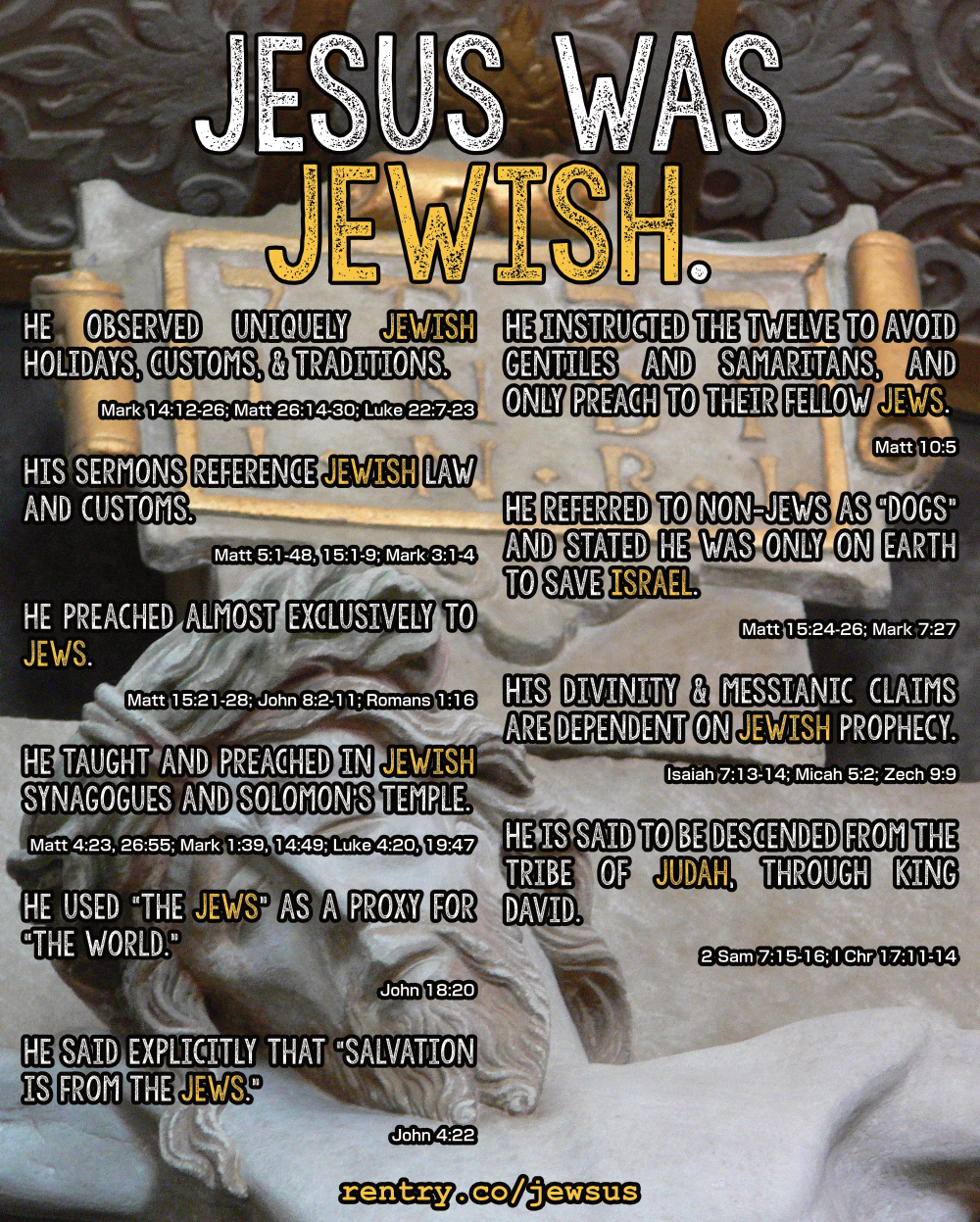
Jesus observed uniquely Jewish holidays, customs, and traditions.
One of the most famous stories in the gospels is the Last Supper. This event set the groundwork for the Eucharist, or communion, ritual observed by millions of Christians (including Mormons as a sacrament) worldwide.
The Last Supper was, more specifically, a Passover celebration. This is a uniquely Jewish holiday with no analogue found in any other religion, spirituality, or human culture. It celebrates the genocide of Egyptian boys as retribution for Pharaoh's heart being hardened, yet again, by Yahweh. This story can be found in the book of Exodus.
Scripture describes the extremely Jewish Passover celebration officiated by Jesus in great detail. The relationship between Passover and the Last Supper is incontrovertible, and a key element the entire narrative. Never in human history, until post-WWII Zionism, have non-Jews ever been recorded as observing Passover. This a cultural, religious, and ethnic holiday exclusive to Jews.
This is but one of many examples of Jesus observing Jewish customs and traditions. Many of the stories in the gospels are incomprehensible to non-Jews unless accompanied by footnotes, and even separate study guides, explaining the nuances of Jewish culture, belief, tradition, law, and religious observance.
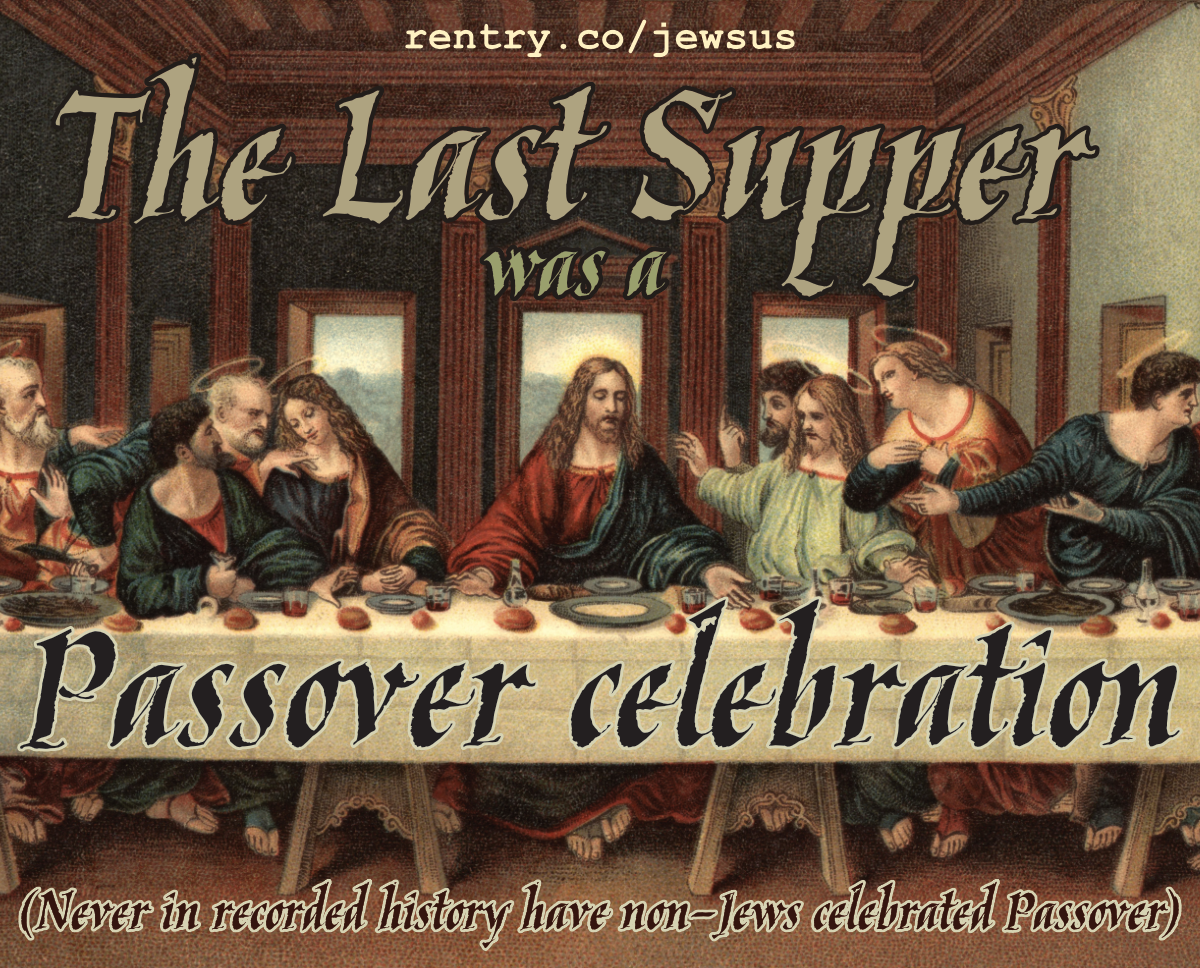
[Matthew 26:17-30](https://biblehub.com/matthew/26.htm#17
Preparing the Passover
[17] On the first day of the Feast of Unleavened Bread, the disciples came to Jesus and asked, “Where do you want us to prepare for You to eat the Passover?”
[18] He answered, “Go into the city to a certain man and tell him that the Teacher says, ‘My time is near. I will keep the Passover with My disciples at your house.’ ” [19] So the disciples did as Jesus had directed them and prepared the Passover.
Preparing the Passover
[12] On the first day of the Feast of Unleavened Bread, when the Passover lamb was to be sacrificed, Jesus’ disciples asked Him, “Where do You want us to prepare for You to eat the Passover?”
[13] So He sent two of His disciples and told them, “Go into the city, and a man carrying a jug of water will meet you. Follow him, [14] and whichever house he enters, say to the owner, ‘The Teacher asks: Where is My guest room, where I may eat the Passover with My disciples?’ [15] And he will show you a large upper room, furnished and ready. Make preparations for us there.”
[16] So the disciples left and went into the city, where they found everything as Jesus had described. And they prepared the Passover.
Preparing the Passover
[7] Then came the day of Unleavened Bread on which the Passover lamb was to be sacrificed. [8] Jesus sent Peter and John, saying, “Go and prepare for us to eat the Passover.”
[9] “Where do You want us to prepare it?” they asked.
[10] He answered, “When you enter the city, a man carrying a jug of water will meet you. Follow him to the house he enters, [11] and say to the owner of that house, ‘The Teacher asks: Where is the guest room, where I may eat the Passover with My disciples?’ [12] And he will show you a large upper room, already furnished. Make preparations there.”
[13] So they went and found it just as Jesus had told them. And they prepared the Passover.
Jesus preached almost exclusively to Jews, referred to non-Jews as "dogs," and stated he only came to "save Israel."
Jesus's ministry among the Jews - the descendants of the ancient Hebrews (Israelites), who resided in what came to be known as Palestine (a term, among others, used since antiquity to refer to the region) - is well-documented in the bible. He presented no similar ministry outside of Judea and the Jewish community there, and when he encountered non-Jews, his behavior was more than a little questionable.
In the following passage, Jesus clearly indicates his ministry is not for everyone; it is for the "lost sheep of the house of Israel." This is exclusively the Jewish people. He denigrates the woman because she is not Jewish, before finally agreeing to heal her daughter.
This story is seen as a tale of Jesus's love and mercy, but the reality is, he insulted a woman whose daughter was ill and made her beg for help before giving in. This is sadistic, cruel behavior which causes unnecessary suffering for nothing more than one's own entertainment.
The Faith of the Canaanite Woman
[21] Leaving that place, Jesus withdrew to the district of Tyre and Sidon. [22] And a Canaanite woman from that region came to Him, crying out, “Lord, Son of David, have mercy on me! My daughter is miserably possessed by a demon.”
[23] But Jesus did not answer a word. So His disciples came and urged Him, “Send her away, for she keeps crying out after us.”
[24] He answered, “I was sent only to the lost sheep of the house of Israel.”
[25] The woman came and knelt before Him. “Lord, help me!” she said.
[26] But Jesus replied, “It is not right to take the children’s bread and toss it to the dogs.”
[27] “Yes, Lord,” she said, “even the dogs eat the crumbs that fall from their master’s table.”
[28] “O woman,” Jesus answered, “your faith is great! Let it be done for you as you desire.” And her daughter was healed from that very hour.
This next story is set at the Jewish temple in Judea. The events described certainly did not transpire in a Greek or Roman temple. Not only that, but the cast of characters described are Jewish religious leaders (Pharisees) who rely on Jewish law (the books of Moses) to form the basis of their argument.
This only occurs within a Jewish community. Jewish law has no authority outside the Jewish people. It would make no sense for non-Jews to go to a non-Jewish intellectual for advice on how to deal with matters of exclusively and explicitly Jewish law. It would also make no sense for Jews to go to a non-Jewish intellectual for the same. Jews only seek counsel from other Jews in matters of Jewish law.
The Woman Caught in Adultery
[1] But Jesus went to the Mount of Olives.
[2] Early in the morning He went back into the temple courts. All the people came to Him, and He sat down to teach them. [3] The scribes and Pharisees, however, brought to Him a woman caught in adultery. They made her stand before them [4] and said, “Teacher, this woman was caught in the act of adultery. [5] In the Law Moses commanded us to stone such a woman. So what do You say?”
[6] They said this to test Him, in order to have a basis for accusing Him. But Jesus bent down and began to write on the ground with His finger.
[7] When they continued to question Him, He straightened up and said to them, “Let him who is without sin among you be the first to cast a stone at her.” [8] And again He bent down and wrote on the ground.
[9] When they heard this, they began to go away one by one, beginning with the older ones, until only Jesus was left, with the woman standing there. [10] Then Jesus straightened up and asked her, “Woman, where are your accusers?d Has no one condemned you?”
[11] “No one, Lord,” she answered.
“Then neither do I condemn you,” Jesus declared. “Now go and sin no more.”
Furthermore, Jesus instructed the twelve disciples to avoid interacting with and preaching to non-Jews. He made this very clear in the following passage.
These twelve Jesus sent out with the following instructions: “Do not go onto the road of the Gentiles or enter any town of the Samaritans.”
Jesus specifically taught in Jewish synagogues and the Jewish temple.
Jesus lived and preached within the Jewish community. This is why specific language referring to exclusively Jewish locations and institutions is used in scripture.
Every reference to a synagogue in the gospels refers to a Jewish place of worship and gathering. It never refers to a gathering place for anyone but exclusively Jews.
Jesus went throughout Galilee, teaching in their synagogues, preaching the gospel of the kingdom, and healing every disease and sickness among the people.
So He went throughout Galilee, preaching in their synagogues and driving out demons.
Then He rolled up the scroll, returned it to the attendant, and sat down. The eyes of everyone in the synagogue were fixed on Him,
Again, the reference here to the "temple" and "temple courts" refers to the Jewish temple, not any Greco-Roman pagan temples.
At that time Jesus said to the crowd, “Have you come out with swords and clubs to arrest Me as you would an outlaw? Every day I sat teaching in the temple courts, and you did not arrest Me.
Every day I was with you, teaching in the temple courts, and you did not arrest Me. But this has happened that the Scriptures would be fulfilled.”
Jesus was teaching at the temple every day, but the chief priests, scribes, and leaders of the people were intent on killing Him.
Jesus's sermons reference Jewish laws and customs.
The entirety of Jesus's famous Sermon on the Mount comes from Jewish law and scripture. Every time Jesus says "you have heard..." he is explicitly referring to Jewish laws, which is why his references can be found in the Torah - the first five books of the Christian bible's old testament.
You may read the entire sermon here.
Next up, this short episode from the gospel of Matthew describes Jesus discussing Jewish law, Jewish commandments, and Jewish culture. The "traditions of the elders" explicitly refers to Jewish custom, rather than some all-encompassing metaphor for tradition in all cultures worldwide.
Further, Jesus references a Jewish text - the book of Isaiah - in his response.
The Tradition of the Elders
[1] Then some Pharisees and scribes came to Jesus from Jerusalem and asked, [2] “Why do Your disciples break the tradition of the elders? They do not wash their hands before they eat.”
[3] Jesus replied, “And why do you break the command of God for the sake of your tradition? [4] For God said, ‘Honor your father and mother’ and ‘Anyone who curses his father or mother must be put to death.’ [5] But you say that if anyone says to his father or mother, ‘Whatever you would have received from me is a gift devoted to God,’ [6] he need not honor his father or mother with it. Thus you nullify the word of God for the sake of your tradition. [7] You hypocrites! Isaiah prophesied correctly about you:
[8]‘These people honor Me with their lips,
but their hearts are far from Me.
[9] They worship Me in vain;
they teach as doctrine the precepts of men.’”
In this third example, Jesus references the Sabbath, which is an exclusively Jewish term and custom. Once again, Jesus is at a Jewish synagogue, and the Jewish leaders there are watching to see how he would behave on the sacred Sabbath.
[1] Once again Jesus entered the synagogue, and a man with a withered hand was there. [2] In order to accuse Jesus, they were watching to see if He would heal on the Sabbath.
[3] Then Jesus said to the man with the withered hand, “Stand up among us.” [4] And He asked them, “Which is lawful on the Sabbath: to do good or to do evil, to save life or to destroy it?”
But they were silent.
Jesus directly and explicitly credits Jews with being the source of the gospel message of salvation.
This is not up for debate: all translations and all original manuscripts with this verse say exactly the same thing: Salvation is from the Jews. Jesus gave the Jews the message of salvation. They were therefore the bearers of the gospel message.
The fact that Jesus labeled some Jews the so-called "Synagogue of Satan" has no bearing whatsoever on Jesus's Jewish ethnic heritage and ancestry.
You worship what you do not know; we worship what we do know, for salvation is from the Jews.
Jesus explicitly used Jews as a proxy for "the world."
This is an important passage, because it adds context for the scope of Jesus's ministry, and how he viewed his people. Like all ethnic groups with significant in-group preference, Jesus's whole world was his own people. He wasn't on Earth to save anyone but his own fellow Jews.
This is why he claims he's spoken openly to "the world" by teaching in Jewish places of worship and gathering, and by speaking to Jews.
“I have spoken openly to the world,” Jesus answered. “I always taught in the synagogues and at the temple, where all the Jews come together. I said nothing in secret.
As the messiah, Jesus fulfilled explicitly Jewish prophecies.
In the gospels, there are multiple references to Jewish scripture - what Christians call "the old testament" - to explain the arrival and purpose of Jesus. Jesus's coming arrival was never prophesied in any scriptures outside the Jewish people. A non-exhaustive collection of these scriptural references is included here.
Note that these prophecies call out Jesus as the messiah of Israel. This does not include, and has never included, white people of European origin.
[13] Then Isaiah said, “Hear now, O house of David! Is it not enough to try the patience of men? Will you try the patience of my God as well? [14] Therefore the Lord Himself will give you a sign: Behold, the virgin will be with child and will give birth to a son, and will call Him Immanuel. [15] By the time He knows enough to reject evil and choose good, He will be eating curds and honey. [16] For before the boy knows enough to reject evil and choose good, the land of the two kings you dread will be laid waste.
But you, Bethlehem Ephrathah,
who are small among the clans of Judah,
out of you will come forth for Me
One to be ruler over Israel—
One whose origins are of old,
from the days of eternity.
Rejoice greatly, O Daughter of Zion!
Shout in triumph, O Daughter of Jerusalem!
See, your King comes to you,
righteous and victorious,
humble and riding on a donkey,
on a colt, the foal of a donkey.
This longer excerpt from both I Chronicles and 2 Samuel highlights the ethnic origins of Jesus as told to David, the king of the Jews.
Moreover, I declare to you that the LORD will build a house for you. [11] And when your days are fulfilled and you go to be with your fathers, I will raise up your descendant after you, one of your own sons, and I will establish his kingdom. [12] He will build a house for Me, and I will establish his throne forever. [13] I will be his Father, and he will be My son. And I will never remove My loving devotion from him as I removed it from your predecessor. [14] But I will set him over My house and My kingdom forever, and his throne will be established forever.”
The LORD declares to you that He Himself will establish a house for you. [12] And when your days are fulfilled and you rest with your fathers, I will raise up your descendant after you, who will come from your own body, and I will establish his kingdom. [13] He will build a house for My Name, and I will establish the throne of his kingdom forever. [14] I will be his Father, and he will be My son. When he does wrong, I will discipline him with the rod of men and with the blows of the sons of men.
[15] But My loving devotion will never be removed from him as I removed it from Saul, whom I moved out of your way. [16] Your house and kingdom will endure forever before Me, and your throne will be established forever.”
Jesus's ethnic origins are not up for debate. The only "evidence" of his non-Jewish origins is a convoluted web of mental gymnastics and invented "translations" of scripture, all of which are maliciously designed to falsely present the claim Jesus wasn't Jewish. There was literally nothing not Jewish about Jesus's ministry. Most of his sermons would have sounded like a series of non-sequiturs to any Greek or Roman of his era who might be totally unfamiliar with Jewish law, prophecy, scripture, tradition, and practice. It is intolerably dishonest to claim Jesus was anything but a Jewish man. Don't spread lies. Allow the truth to stand on its own, and if it can't survive public scrutiny, maybe it wasn't eternal truth, after all.
Read more essays here.