On Aryanism
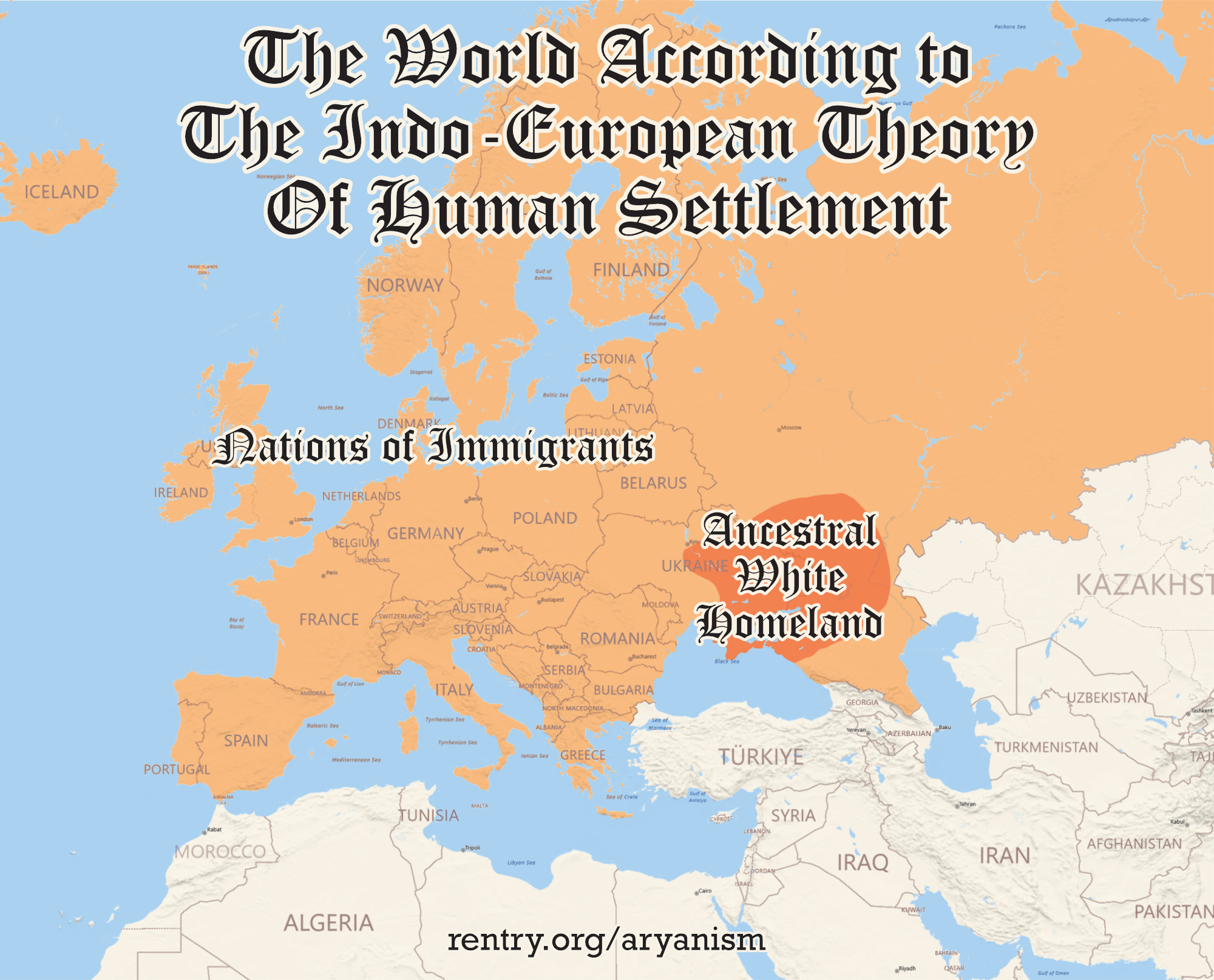
"Aryan" (and derivatives of this word) has become synonymous with "white European," but is this accurate?
Let's take a look at the term "Aryan," its etymology, and how its definition has mysteriously changed over time.
Part 1: The etymology of the term Aryan
Let's first look at the Online Etymology Dictionary (archive).
Earliest known usage:
c. 1600, as a term in classical history, from Latin Arianus, Ariana, from Greek Aria, Areia, names applied in classical times to the eastern part of ancient Persia and to its inhabitants. Ancient Persians used the name in reference to themselves (Old Persian ariya-), hence Iran. Ultimately from Sanskrit arya- "compatriot;" in later language "noble, of good family."
So it was used to refer to ancient Persians, who were not ancient Europeans. Don't get me wrong - Persia was a really cool civilization, and Persians have some impressive accomplishments in their people's history, but they're not European, and certainly are not northern European.
Also the name Sanskrit-speaking invaders of India gave themselves in the ancient texts. Thus it was the word early 19c. European philologists (Friedrich Schlegel, 1819, who linked it with German Ehre "honor") applied to the ancient people we now call Indo-Europeans, suspecting that this is what they called themselves.
This is where "Aryan" mysteriously turned from a term used for a specific ethnic group into a term used to conflate similar linguistics, to position otherwise unrelated ethnic groups as related. Now, why would someone do this? We can speculate all day, but I found this academic paper (archive) after a quick search.
Specifically, the man responsible for popularizing the term "Aryan" as a linguistic demographic identifier was romantically and sexually involved with a Jewish woman, whose father was a well-known Jewish philosopher. So it certainly goes to follow that his adulterous affair with a Jewess influenced his views on European ethnic groups and Europeans as a whole (i.e. the white race).
The fact that Aryan was coined as a linguistic identifier is further reinforced by the following citation:
This use is attested in English from 1851. In German from 1845 it was specifically contrasted to Semitic (Lassen).
And according to The Palestine Diary (Robert John and Sami Hadawi, 1970), the term Semitic originated thusly:
The term 'semitic' was coined in 1781 by A.L. Schoezer to designate the Hebrew, Aramaic and Arabic languages and the peoples who spoke them, based on the Biblical division of the post-diluvian world into groups descended from Noah's sons Shem, Ham and Japheth.
"Semitic" has always been a linguistic rather than ethnic term; "Aryan" was turned into a linguistic term by subversive Jews and Jew-adjacents in academia.
Going further:
German philologist Max Müller (1823-1900) popularized Aryan in his writings on comparative linguistics, recommending it as the name (replacing Indo-European, Indo-Germanic, Caucasian, Japhetic) for the group of related, inflected languages connected with these peoples, mostly found in Europe but also including Sanskrit and Persian.
This is just nonsensical. Jews in Germany essentially invented a linguistic theory that allowed them to put forth the false narrative that the white race monolithically descended from tribes of invaders from another part of the world - an ideal that we can now see today was to prepare the white race for accepting the claim that we have no rightful homeland anywhere on Earth.
Max Müller, in his later years, expressed a bizarre level of admiration for India and the Indian people as superior to white Europeans, as quoted here (archive).
If I were to look over the whole world to find out the country most richly endowed with all the wealth, power, and beauty that nature can bestow—in some parts a very paradise on earth—I should point to India. If I were asked under what sky the human mind has most full developed some of its choicest gifts, has most deeply pondered on the greatest problems of life, and has found solutions of some of them which well deserve the attention even of those who have studied Plato and Kant—I should point to India. And if I were to ask myself from what literature we, here in Europe, we who have been nurtured almost exclusively on the thoughts of Greeks and Romans, and of one Semitic race, the Jewish, may draw that corrective which is most wanted in order to make our inner life more perfect, more comprehensive, more universal, in fact more truly human, a life, not for this life only, but a transfigured and eternal life—again I should point to India.
For a German, he sure doesn't give any credit to the Germanics for our innate morality and virtue. He instead wrongly ascribes our culture and civilization to the peoples of the Mediterranean - who, while accomplishing many great things, were not the sole source of Europe's life, and were not even credibly the majority source of the cultures of the common people throughout Europe. The Germanics added an awful lot to the mix. The Roman system of government was modified with what we've come to know as "British Common Law," but the fact is, the natural societies formed by the ancient Germanics exhibited the same instinctive notions of self-determination and liberty, and effectively respected what we consider "common law" today.
Beyond that, he gives credit to the Jews, who have offered nothing particularly constructive for the white race. We learned usury from them, and how to exploit non-white tribes as slave labor. We learned how to build ever-expanding empires through their deep pockets and endless quest for political power. More recently, they have taught us how to invade and tyrannize their neighbors, while they genocide their own brethren for all the world to see.
The values we consider white (or those that are derided by leftists as "whiteness," "white supremacy," and/or "white privilege") are not the product of any tribe of people from Palestine. The values we consider white are primarily the product of the Germanics. We should give credit where credit is clearly due, and ignorance is no excuse here: Germania as a text has been known to German intellectuals and philosophers since at least the 16th century, when the nascent Enlightenment movement prompted Germanic philosophers to learn as much as they could about what their own ancestors believed about life, existence, and the gods.
And this brings me to my next problem with the term "Aryan".
Part 2: Comparing Germanic and so-called Aryan culture
I don't doubt that various human migrations into Europe had some lasting effect.
But our ancestors' way of life, thousands of years after those supposed Aryan migrations, was not reflective of Aryan culture. It was reflective of Germanic culture, which is markedly different from Aryan culture.
Just read Germania (archive) and Hávamál (archive). The culture reflected in those texts is missing key elements of what we contemporarily consider to be "Aryan culture." The Germanics had no concept of aristocracy, for example. In fact, Hávamál has a section of proverbs specifically on the fallacy of pursuing wisdom and knowledge as the ultimate goal in one's life.
Middling wise should each man be,
never should he be too wise;
they are the men that live fairest
who choose not to know many things.
Middling wise should each man be
never should he be too wise;
because a wise man’s heart
seldom becomes glad
if he has gotten too much wisdom.
Middling wise should each man be
never should he be too wise;
who know not beforehand their own fate,
they are the freest from care.
Thorstein Mayfield, translator, The Poetic Edda
They were a people fully capable of the centralized, organized civilization found in Rome (and elsewhere), but evidently consciously chose a different way of life.
That tells me they were different in essence. Their people were fundamentally different from the peoples more interested in centralizing control of populations, establishing aristocracies and nobilities which exert authority over "lower classes," etc.
The romanticization of so-called Aryanism is far more ignorant of self-evident facts than the romanticization of Germanic culture, which was alive and thriving long after Aryans supposedly conquered them and replaced their genetic ancestry, and most importantly, Germanic culture remains clearly evident among the descendants of those peoples to this very day.
The so-called Aryan way of life is entirely foreign to me as a Germanic. I'm not Aryan. I was never Aryan. My people were never Aryan. They weren't from Persia, they weren't nomads, they weren't aristocrats. They were highly intelligent, but they also had a hardwired need for self-determination and liberty. That drive for liberty is what kept them from building the centralized, bureaucratic government structures of southern Europe. It's what led America's founders to decide independence was better than living under the predictable tyranny of the British Empire - and to build a new nation based on the idea of independent states, federated together to ensure their mutual independence and liberty.
The Germanics knew what they would give up if they united politically as a single nation with a single government. They knew the cost, because they were intelligent, and could not only see the consequences in living color by watching their Roman neighbors, but also extrapolate onto their own people how such a government might work out. They intentionally chose a non-aristocratic, unstratified social structure.
Part 3: A note on proto-languages and proto-cultures
This excerpt from an academic paper on Indo-Europeanism (archive) illustrates very well the universalist nature of the theory, as well underscoring its origins in common linguistics, which are never an indicator of common ancestral origin. Every bit of exploration and discovery that has been conducted since the invention of this theory has been prejudiced in favor of it, and it has become "scientific fact" in the same way that climate change and the efficacy of COVID vaccines are "scientific fact."
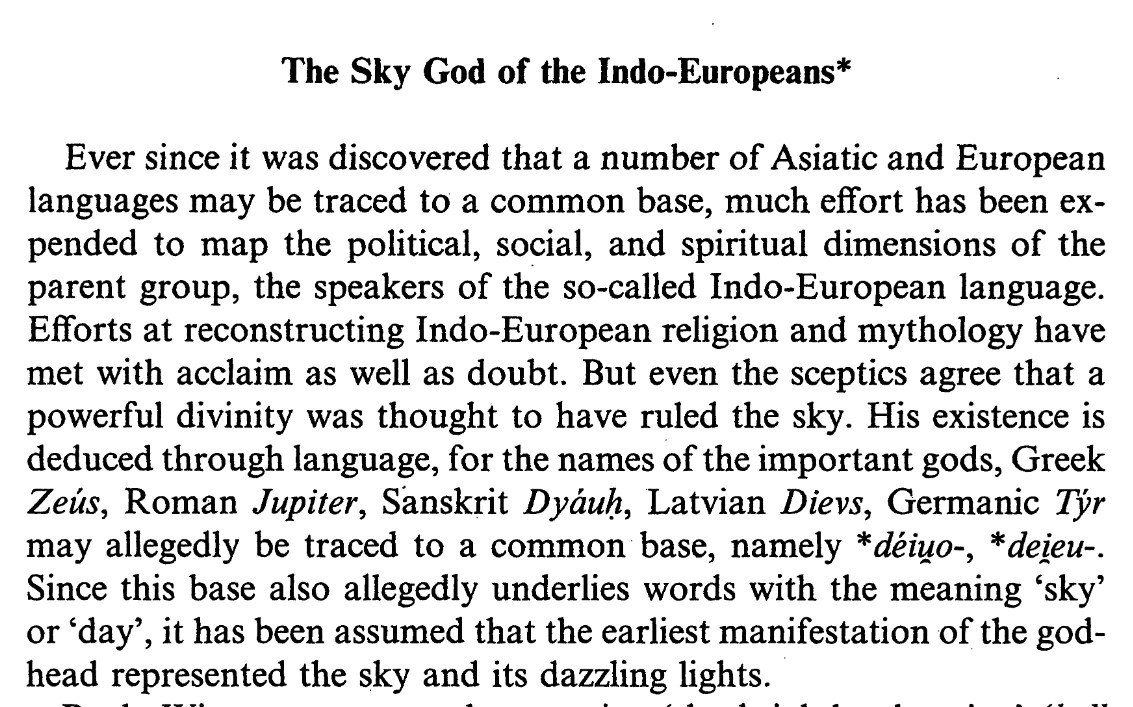
Proto-languages and proto-cultures within this Indo-European framework are entirely fabricated from whole cloth by academia. Most content on this subject is a reiteration of a false, modern, Jew-originated narrative of white history that deprives us of our ancestral heritage and our immortal ties to our ancestral homelands, by insisting our ancestors really came from somewhere else, and have always been conquering invaders who take over and impose their will on an unwilling native population deemed too inferior to be granted self-determination.
This is all a lie, and it's entirely supported by the bible's history, not by any real, recorded history. The bible claims we all descend from the three sons of Noah, which is why "Japhetic" used to be a term used to refer to white Europeans. These linguistic anthropological theories have been used since at least the latter half of the 19th century to claim that all white Europeans descend from a single nation of light-skinned people who were not indigenous to the European continent, but instead invaded, conquered, and demographically replaced the previous inhabitants to the degree that the material culture of the inhabitants was usurped and erased.
This is observably false. The white people of Europe are not all the same, nor do they share one, collective culture and history. Various geographic regions within the continent have shared heritage, which we can see in similarities of ritual, pagan cosmology, and physical artifacts. This observation has been extrapolated in modern times to conclude that the entire white race shares a single common origin, and our differences evolved over time. While this is not an impossible or implausible hypothesis, it has been presented as proven, scientific fact, and all anthropological and sociological research must be based on this premise if it is to be taken seriously.
Consider instead that our differences have always existed, and that we were once more different than we are today. According to Tacitus, the ancient Germanics were so ethnically homogeneous, they were uniformly tall and broad, with curly red hair and bright blue eyes. That ethnic composition has changed dramatically since its record in 98 CE, yet the ancient ways of the Germanics have persisted in their descendants to this day. This is something we can observe firsthand, by recognizing the behaviors of white Germanics in small communities, insulated from the external forces of both globalism in pop culture, and global migration of nonwhites to the white world. Our ways are obviously not universal, as the rest of the world has never naturally adopted our way of life. Rather than attempting to unite ancient languages, cultures, and peoples under a single proto-race, we should look at our ancestral tribes as unique and distinct, with their own origin myths and holistic worldviews that aren't necessarily identical to - or compatible with - anyone else's.
This isn't a bad thing. It isn't something we need to conquer, overcome, or suppress. It's natural, and what diversity really means is that we're not all the same, and we should stop trying to formulate theories which hypothesize that we came from Sameness.
Read more essays here.