19th Century Asia

All the content in this article is based on true historical events without any fictional elements. You can read these interesting historical introductions—they are a bit lengthy but will help you better enjoy interacting with this bot.
For clarity, in the text, "China" refers to "all regimes that have existed on the land of mainland China" as well as "the Qing Empire," rather than the present-day People's Republic of China.
Table of Contents
- 19th Century Asia
- Table of Contents
- About This Bot
- How to Play This Series of Bots?
- Overall Lore Primer
- Qing Empire
- The Conquerors of the East: Qing Empire
- The Overlord of All Under Heaven: Why Ancient China Refused Equal Dialogue with the West
- "The Hermit Kingdom" of Joseon and Its Chinese Big Brother
- The World's First Drug War: When the British Empire Became the World's Biggest Drug Dealer, The First Opium War
- The Second Opium War: When Queen Victoria Sent Troops to Burn China's "Versailles"
- Jesus's "Chinese Brother" and His Bloody Kingdom: The Taiping Rebellion
- China's "Wild West" War - The Xinjiang Muslim Rebellion: A General, an Uprising, and Russian Conspiracy
- China's First "Technological Revolution": The Self-Strengthening Movement and Its Tragic End
- China's "Silicon Valley Dreamers": The Reform Faction Sidelined by the Imperial Court
- The Qing Dynasty's "Ironclad Fleet" Beiyang Navy: A Misunderstood Modernization Attempt
- The Collapse of "Asia's First Fleet": A Decisive War Changing East Asia's Landscape - The First Sino-Japanese War
- "War Between God and Spirits" Missionary Cases: Religious Conflict Storm in the Qing Dynasty
- "Bullet-proof" Angry Farmers VS. Western Powers: A Disastrous National Resistance
- "Eastern Versailles" and "Fairy's Crystal Palace": Vanished Paradise and Surviving Marvel
- "Ancient China's College Entrance Exam": From Social Ladder to Mental Prison
- "China's Reluctant First Foreign Ministry": Birth of Modern Chinese Diplomacy
- Important Characters Of Late Qing Empire
- Story Opening Narrations
- Opening 1: The Golden Ticket: Becoming China's Top Scholar (No specific year).
- Opening 2: Between Empire and Fury: A Qing Official's Dilemma (Post-1850).
- Opening 3: Trapped Between History's Pages: The Battle of Bali Bridge (1857).
- Opening 4: The Sacking of Summer Palace (1860).
- Opening 5: Heaven's General at the Crossroads (1861).
- Opening 6: The Hollow Fleet: Yellow Sea (1895).
- Opening 7: The Fateful Negotiation: China's Darkest Hour (1895)
- Opening 8: The Boxer Uprising: China's Desperate Gamble
- Opening 9: Besieged: The Last Stand in Beijing
About This Bot
19th Century Asia is a vast historical series, created because I couldn't find a suitable history bot with a modern-era theme. I chose 1850–1900 as the story's background because these fifty years had an immense, extremely immense, and profound impact on East Asian countries, including China, Japan, and Korea. However, no one seems to know what actually happened during this period. I understand that some people may not want to engage with this bot due to a lack of understanding of the historical context, which is why I wrote this Rentry.
This series is divided into three lorebooks: Qing Dynasty (both bilingual versions completed), Japan (only the Chinese version completed), and International (not yet created). Due to the sheer scale of the series, it requires a significant amount of time to develop.
In any case, as always, if you're tired of dragons, adventurers, and magic, this series will be one of the best alternatives.
How to Play This Series of Bots?
After reading this article, you can try to immerse yourself in that era through this bot. You don’t need to know too much at once, but if you can grasp some background stories, it will be even better. This will help you start the story more smoothly, which is why I wrote this Rentry article.
If you don’t want to know too many details about the background story, you can skip directly to the "Story Opening Explanation" section.
Overall Lore Primer
In fifty short years, East Asia's ancient order crumbled. The mighty Qing Empire—convinced of its celestial superiority—faced crushing defeats in the Opium Wars and Sino-Japanese War. Despite belated reforms, China's imperial court watched helplessly as European powers and Japan carved its territory into foreign concessions.
Across the sea, Japan executed history's most successful national reinvention. The Meiji Restoration dismantled a thousand years of feudalism in mere decades. By century's end, Japan had defeated both China and Russia, shocking Western powers who never imagined an Asian nation joining their ranks.
Korea initially repelled Western intrusions, driving away both French and American expeditions. But this false victory led to fatal complacency. Rejecting modernization, the "Hermit Kingdom" soon fell prey to Japanese imperialism.
You now hold the power to navigate this pivotal era when ancient empires collapsed and new powers emerged. Step into history's crucible—your journey through Asia's great transformation begins now.
The series will have three main storyteller bots and several character bots. If you want to play from the Qing Empire's perspective, please use 19th Century Asia, Great Qing, 1850~1900. The Japan perspective and International perspective will take some time to be completed.
Qing Empire
The Conquerors of the East: Qing Empire
The Qing Empire—an empire founded by Manchu nomadic cavalry—rose from the frontiers much like the Mongol Empire, conquering the ancient civilizations of East Asia. These Manchu warriors from northeastern China, endowed with remarkable military prowess, overthrew the Ming Dynasty and established the last great empire of Asia.
As time passed, these conquerors were gradually assimilated by the culture they had subdued. The Qing Empire transformed from a foreign regime into a legitimate Chinese dynasty, successfully gaining recognition from its Han Chinese subjects. At its peak, the Qing Empire stood alongside Louis XIV’s France and the Ottoman Empire as a global powerhouse, ruling vast territories and abundant resources.
However, the empire's decline stemmed from its "Celestial Empire" mentality—a belief that it stood at the center of the world. This arrogance rendered the Qing incapable of adapting to the Western Industrial Revolution and colonial expansion, much like an enormous ship unable to change course, ultimately swallowed by the tides of history.
This "Celestial Empire" ideology is of utmost importance, as it was one of the fundamental reasons the Qing Empire failed to reform. The following section will provide further explanation.
 The image above is the national flag of the Qing Empire, known as the "Yellow Dragon Flag."
The Overlord of All Under Heaven: Why Ancient China Refused Equal Dialogue with the West
Imagine a world order lasting 3000 years where one country consistently viewed itself as the only center of global civilization. This isn't science fiction—this was ancient China's "Celestial Empire" mindset.
Since the Zhou Dynasty period before the Common Era, Chinese rulers established a concentric worldview: China at the center, surrounded by tributary vassal states, with "barbarians" in the outermost ring. This was like a solar system model of the universe, with China as the sun and other countries as planets orbiting around it.
Before Western fleets arrived, this system worked well. As Asia's most powerful civilization, China indeed became the regional hegemon, establishing an international relations "tributary system" that required neighboring countries to bow down to the "Son of Heaven."
When British and French envoys demanded "equal" trade with the Qing Empire, it seemed utterly absurd to the Chinese. This was equivalent to asking the British Queen to sit down to dinner as an equal with a London street vendor!
Even when faced with advanced weapons and technology brought by the Industrial Revolution, the deeply ingrained Celestial Empire mentality made Chinese leadership refuse to change. This cultural arrogance ultimately became China's greatest obstacle to integration into the modern world, like a king of dancers refusing to learn new steps, eventually being escorted off the stage.
Ancient global diplomatic scheme, China's tributary system: Imagine a seemingly unequal deal: you address someone as "Your Majesty," send some small gifts, and then he rewards you with luxury items worth ten times more, plus promises to send armies to protect you when you're in trouble. Does this sound like a scam? This was actually China's "tributary system" that lasted for thousands of years. This system was one of the most successful diplomatic methods in world history. Neighboring countries only needed to formally acknowledge the Chinese emperor's authority—basically saying "You're so great"—and then offer some local specialties as tribute. In return, China would send back "rewards" worth far more than the tribute items. Imagine the US President accepting maple syrup from Canada, then giving back an aircraft carrier! This was the economic reality of tributary trade. Even better, although these countries were theoretically China's "subjects," China rarely interfered in their internal affairs. The Chinese emperor only needed nominal respect, while neighboring countries gained economic benefits and military protection. It was like an ancient version of a "protection fee" system, but reversed—you give a little, but receive much more than you give. No wonder this system was maintained for thousands of years!
"The Hermit Kingdom" of Joseon and Its Chinese Big Brother
Imagine a little brother who strictly follows family rules, visiting his big brother's home every year with carefully prepared gifts, listening to life advice, then going home to follow it—this was the tributary relationship between Joseon and the Qing Dynasty.
The Joseon Kingdom (1392-1910), a monarchical state ruled by the Yi family, located on a peninsula at China's northeastern border, was the most faithful follower in East Asia's Confucian civilization circle. They had brilliant cultural achievements:
- Invented the world's most scientific alphabetic writing system, "Hunminjeongeum" (modern Korean)
- Created unique ceramic art and architectural styles
- Established Asia's earliest water rain gauge
But in international relations, Joseon maintained a "tributary relationship" with the Qing Dynasty (in fact, they were the Qing Dynasty's last tributary state):
- The Joseon king needed the Qing Emperor's "investiture" to rule legally
- Three times a year, envoy delegations were sent with tributes (ginseng, cloth, paper) to Beijing
- Joseon had to use the Qing Dynasty's reign names and acknowledge itself as a "vassal state" in official documents
- Permission from the Qing Dynasty was required before handling diplomatic affairs
Interestingly, while Joseon elites outwardly submitted, privately they considered themselves more orthodox inheritors of Confucian civilization than the Qing Dynasty. They called themselves "Little China" and viewed themselves as guardians of orthodox Chinese culture, while the Manchu-ruled Qing Dynasty was seen as "barbarian."
This nuanced tributary relationship was maintained for hundreds of years, until the emergence of Western powers and newly rising Asian powers in the late 19th century completely broke this ancient East Asian order.

This is the national flag of the Joseon Kingdom.
The World's First Drug War: When the British Empire Became the World's Biggest Drug Dealer, The First Opium War
Imagine this: a superpower begins mass drug trafficking to another country to solve its trade deficit, then launches a war when the target country destroys the drugs. This isn't a Netflix crime drama, but actual history from 1840.
It all began with the British addiction to Chinese tea. British Empire citizens consumed millions of pounds of tea annually, causing silver to flow continuously into China. Facing this fiscal nightmare, Britain found the "perfect solution": selling opium to the Chinese.
Soon, Chinese cities were filled with opium dens, with millions of people falling into addiction. Seeing the country being destroyed by drugs, Chinese official Lin Zexu ordered the seizure and burning of all opium—including large stocks belonging to British merchants.
The British government—then the world's largest drug pusher—was furious. When British soldiers killed Chinese civilians in Hong Kong, the powder keg was ignited.
The subsequent war was completely unequal: British steam warships versus Chinese wooden sailboats, modern guns against ancient matchlocks. China was badly defeated, but more fatally: imperial officials concealed the full truth of the defeat from the emperor, depriving China of the opportunity to learn and reform.
 Illustration of Chinese People Smoking Opium
 Naval Battle Illustration of the First Opium War
The Second Opium War: When Queen Victoria Sent Troops to Burn China's "Versailles"
Imagine if Russian troops suddenly stormed Buckingham Palace or the White House, looted everything, then set it on fire - this is what happened in China in 1860.
The Second Opium War (1856-1860) was the "sequel" to the first drug war, but this time Britain brought its French friends along. The superficial reason was that Chinese officials boarded a ship flying the British flag and arrested Chinese sailors, but the real reasons were that Western powers wanted more:
- More Chinese cities opened for trade
- The right for foreign diplomats to be stationed in Beijing
- Freedom for missionaries to preach
- Legalization of the opium trade
When the Qing Dynasty resisted these demands, the Anglo-French forces fought all the way to Beijing, destroying the Yuan Ming Yuan (Old Summer Palace) - a royal garden more spectacular than France's Palace of Versailles that was hailed as the "Wonder of the East."
The war ended with the Treaty of Beijing, forcing China to cede more territory (including Kowloon), pay enormous reparations, and accept a series of humiliating terms. This war completely shattered China's status as a world power, beginning a historical period known as the "Century of Humiliation."
 Illustration of the Battle Between the Anglo-French Allied Forces and the Qing Army During the Second Opium War
 Illustration of the Old Summer Palace (Yuan Ming Yuan)
Jesus's "Chinese Brother" and His Bloody Kingdom: The Taiping Rebellion
Imagine a failed school teacher claiming to be Jesus Christ's younger brother, then launching a revolution that caused 20 million deaths. This was Hong Xiuquan and his Taiping Heavenly Kingdom movement (1851-1864).
Hong Xiuquan was originally just a disappointed scholar who failed the imperial examinations multiple times. During a fever-induced delirium, he "saw" himself being taken to heaven, where he met an old man (God) and his eldest son (Jesus). After waking up, Hong Xiuquan became convinced he was Jesus's brother, sent to earth to eliminate "demons" — the Manchu rulers in his eyes.
He founded the "God Worshipping Society" — a bizarre variant of Christianity that mixed Catholicism, Protestantism, and Chinese folk beliefs. This religion advocated:
- Gender equality (extremely radical in China at that time)
- Prohibition of opium and foot binding
- Communal property ownership (an early form of communism)
- Destruction of all traditional Chinese idols and temples
The Taiping Rebellion swept through southern China, establishing its capital in Nanjing, and at its peak controlled 17 provinces and 30 million people. But ultimately, internal corruption, power struggles, and encirclement by Qing forces led this "Chinese version of the Apocalypse" to a bloody end, with a death toll 10 times that of the American Civil War.
 Portrait of Hong Xiuquan, Leader of the Taiping Heavenly Kingdom
 Map of the Taiping Rebellion: The red areas indicate territories controlled by the Taiping Heavenly Kingdom, while the red-and-yellow striped areas represent another rebellion.
China's "Wild West" War - The Xinjiang Muslim Rebellion: A General, an Uprising, and Russian Conspiracy
Imagine a Western massacre occurring during the same period as the American Civil War, but 10 times larger in scale. This was the Xinjiang Muslim Rebellion (1862-1877)—a Muslim uprising in China's northwest that caused nearly 10 million deaths.
The causes were complex: religious conflicts, ethnic tensions, economic pressures, and the Qing government's inability to manage frontier regions. When the Taiping Heavenly Kingdom and other rebellions diverted the Qing Dynasty's attention, Muslim communities in the northwest erupted in full-scale resistance.
The hero who emerged was Zuo Zongtang—a 65-year-old general, China's version of Ulysses S. Grant. When he was sent to suppress this rebellion, many believed it was an impossible mission. Yet Zuo Zongtang used calm determination and innovative tactics to lead his army across the vast Gobi Desert, reclaiming lost territories one by one.
Meanwhile behind the scenes, Tsarist Russia was secretly manipulating events. Taking advantage of China's internal chaos, Russian forces occupied the Ili region of Xinjiang, pretending this was only a "temporary" action. In fact, this was a carefully planned land grab, attempting to permanently divide China's northwestern territory.
Zuo Zongtang's military success forced Russia to change its plans. Eventually, in the 1881 Treaty of Saint Petersburg, Russia returned most of the occupied areas but kept some strategic locations—this was one of the rare partial victories among China's "unequal treaties."
China's First "Technological Revolution": The Self-Strengthening Movement and Its Tragic End
Imagine the United States discovering it was 100 years behind in technology after the Civil War, urgently launching a nationwide industrial revolution, yet refusing to change its political system. This was essentially the Qing Dynasty's Self-Strengthening Movement (1861-1895).
After painful lessons from Western firearms, a group of progressive officials—led by Prince Gong Yixin, Li Hongzhang, Zeng Guofan, and Zuo Zongtang—proposed a simple and direct solution: learn Western technology while preserving Chinese traditional values. Their slogan: "Learn the foreigners' techniques to control the foreigners" (use foreign technology to resist foreign invasion).
Highlights of this movement included:
- Fuzhou Mawei Shipyard: China's first modern shipyard, not only building warships but also sending the first group of Chinese students to Britain to study shipbuilding and navigation
- Beiyang Navy: One of Asia's most modernized fleets, possessing world-class warships of the time (ironically, this fleet was later completely defeated by Japan in the First Sino-Japanese War, which will be explained later)
- Dozens of military factories, armories, and other modern industrial facilities
However, the Qing royal family had complicated attitudes toward this movement. They were willing to support technological progress but firmly opposed any political reforms. This was like trying to install a Ferrari engine in a horse carriage—with predictable results. Under resistance from conservatives and Empress Dowager Cixi, the movement ultimately failed to truly modernize China.
 Photograph of the Hanyang Arsenal, one of the construction projects during the Self-Strengthening Movement. After the fall of the Qing Empire, the Hanyang Arsenal became an important factory for the Republic of China, producing weapons to resist Japan.
 Photograph of the Fuzhou Mawei Shipyard
China's "Silicon Valley Dreamers": The Reform Faction Sidelined by the Imperial Court
Imagine a group of corporate executives trying to transform a company from the 1870s into a tech startup, while facing a stubborn board of directors and a CEO refusing to change. This was the situation of the Qing Dynasty's Foreign Affairs Faction—China's first group of "technology progressives."
The Foreign Affairs Faction was a group of elite officials who realized under the powerful ships and weapons of Western powers: China must change or perish. Their core members included:
- Prince Gong Yixin: One of the few enlightened members of the royal family, serving as the high-level protector of the Self-Strengthening Movement
- Li Hongzhang: The most famous leader of the Foreign Affairs group, who established the Beiyang Navy and modern military industries
- Zeng Guofan: A traditional Confucian scholar transformed into a modernization promoter
- Zhang Zhidong: Creator of the "Chinese learning for essence, Western learning for application" theory, founder of the Hanyang Ironworks
- Zuo Zongtang: Military leader of the northwest, promoter of the Fuzhou Shipyard
Their achievements were impressive: establishing China's first modern factories, shipyards, armies, telegraph systems, and railways. But these "reform dreamers" faced court realities including:
- Empress Dowager Cixi controlled the government, extremely sensitive to any reforms threatening her power
- The court diverted precious modernization funds to build luxurious projects like the Summer Palace royal garden
- Conservative Confucian officials viewed them as traitors, constantly reporting their "worship of foreign ways"
- The Foreign Affairs Faction themselves were unwilling to touch political reforms, only wanting to borrow Western technology
Most ironically: when the Beiyang Navy they had spent decades building was destroyed by Japan in the First Sino-Japanese War (1894-1895), these "Chinese dreamers" witnessed firsthand the collapse of their strategy of incomplete reforms.
The Qing Dynasty's "Ironclad Fleet" Beiyang Navy: A Misunderstood Modernization Attempt
Imagine if the US Navy suddenly jumped from the wooden sailing ship era directly to the steam-powered steel warship era—this was China's Beiyang Navy in the 19th century, one of Asia's first modernized fleets.
The Beiyang Navy was established in the 1880s, created single-handedly by Li Hongzhang, known as "China's first modernization promoter." The fundamental differences from traditional Chinese naval forces were:
Traditional Chinese Naval Forces:
- Wooden sailing ships with limited cannons
- Crews mostly consisted of temporarily conscripted fishermen lacking professional training
- Primary mission was fighting pirates and coastal patrol
- Managed separately by different provinces without unified command
Beiyang Navy:
- Imported the most advanced steel warships from Britain and Germany
- Professional officers (many studied in Britain) and regular sailors
- Equipped with rapid-fire guns, torpedoes, and the latest military technology of the time
- Unified command system and modernized training
This fleet was once one of Asia's most powerful naval forces when established, possessing two world-class flagship battleships of the time, "Dingyuan" and "Zhenyuan." The Qing government invested 30 million taels of silver (equivalent to 25% of the national annual income), making this China's first military modernization investment of such scale.
However, although the warships were modern, the command system remained deeply entrenched in ancient bureaucratic thinking, ultimately causing this fleet—which once shocked Western powers—to perform poorly in actual combat, eventually being almost completely destroyed in the First Sino-Japanese War with Japan.
What is ironclad: Ironclads were armored warships covered with iron or steel plates that dominated naval warfare from the 1860s to early 1890s. These steam-powered vessels represented a revolutionary step in naval technology, offering unprecedented protection against enemy fire while carrying increasingly powerful artillery. The ironclad's primary function was to render wooden warships obsolete through their virtual invulnerability to conventional cannon fire. They served as the backbone of naval power during the transition period between traditional wooden sailing ships and the all-steel battleships of the early 20th century. During their brief technological reign, ironclads established a new paradigm in naval strategy, requiring nations to rapidly modernize their fleets or risk military irrelevance in an age of accelerating industrial warfare.
 Photograph of the Beiyang Fleet's Main Battleship: Dingyuan.
 Photograph of China's First Locally Built Ironclad: Pingyuan.
The Collapse of "Asia's First Fleet": A Decisive War Changing East Asia's Landscape - The First Sino-Japanese War
Imagine a boxing match: one side is an overweight, expensively equipped but undertrained veteran boxer, the other is a lighter but disciplined and technically skilled newcomer. This was the First Sino-Japanese War of 1894-1895, a decisive conflict that completely changed the balance of power in East Asia.
This war between China and Japan for control of Korea, although it involved fierce land battles, had its most dramatic part in the naval showdown. The Beiyang Navy—the "First Fleet of Asia" built at enormous cost by the Qing Dynasty—performed heartbreakingly when facing the Japanese Combined Fleet:
The Great Battle of the Yellow Sea (September 1894):
- The Beiyang Fleet technically had advantages: two 7,000-ton capital ships ("Dingyuan" and "Zhenyuan") equipped with 30cm main guns
- However, the Japanese fleet had more concentrated firepower, faster speed, and more unified command
- The Chinese flagship "Zhiyuan" charged toward the Japanese fleet, with Captain Deng Shichang heroically sacrificing himself
- Battle ended with: 4 Chinese warships sunk, remaining vessels escaping to Weihaiwei
The Weihaiwei Tragedy (February 1895):
- The remaining Beiyang Fleet was trapped in the frozen port of Weihaiwei
- Japanese marines captured shore batteries and attacked the Chinese fleet from behind
- Fleet Commander Ding Ruchang committed suicide by poison
- The entire Beiyang Navy was either captured or sunk
After this war, China was forced to sign the Treaty of Shimonoseki, ceding Taiwan and the Liaodong Peninsula, and paying 200 million taels of silver in reparations (4 times the national treasury's income). More critically, it destroyed thirty years of achievement from China's Self-Strengthening Movement, announcing a complete shift in the balance of power in Asia.
 Japanese Ukiyo-e Depicting Japan Defeating the Beiyang Fleet in the Battle of the Yellow Sea.
 Beiyang Fleet Surrendering to the Japanese Navy
 Japanese Army Massacring Chinese Civilians in Lushun (Port Arthur)
"War Between God and Spirits" Missionary Cases: Religious Conflict Storm in the Qing Dynasty
Imagine a group of foreigners suddenly arriving in your community, declaring everything your ancestors believed in to be superstition, and actively recruiting followers to join their religion. This is basically what "missionary cases" were—religious conflict incidents that occurred in 19th century China.
Missionary cases refer to violent conflicts between Chinese people and Western missionaries (mainly Catholic and Protestant missionaries) during the Qing Dynasty. These conflicts began in the 1840s and continued until the early 20th century, with their peak period between 1860-1900, numbering in the hundreds.
Why did these conflicts occur? Because it was a perfect storm:
- Missionaries gained privileges to operate in China's interior through unequal treaties
- Missionaries frequently attacked Chinese traditional customs (ancestor worship, feng shui) as "superstition"
- Chinese converts received protection from foreigners, sometimes evading local legal responsibilities
- Rumors spread widely: horrific tales of missionaries gouging out eyes and kidnapping children to make medicine
The most famous missionary cases include:
- Tianjin Missionary Case (1870): A riot triggered by orphanage rumors, resulting in the French consul being killed
- Yangzhou Missionary Case (1868): Local gentry incited people to attack a British mission station
- Shanxi Missionary Case (1900): During the Boxer Rebellion, almost all missionaries in the entire province were killed
After each missionary case, Western powers would demand compensation, punishment of local officials, and even threaten with warships, further deepening Chinese hostility toward "foreign religions." These religious conflicts actually reflected Chinese society's cultural defense instinct and sense of powerlessness in the face of Western invasion. Eventually, these accumulated grievances ultimately led to the Boxer Rebellion.
 A Chinese illustration depicting a foreign priest gouging out the eyes of Chinese people to make medicine.
"Bullet-proof" Angry Farmers VS. Western Powers: A Disastrous National Resistance
Imagine a group of desperate farmers, believing special rituals could make them impervious to weapons, deciding to drive out all foreigners—this was the Boxer Rebellion, a popular uprising that shocked the world in 1900.
The Boxers originated from secret martial arts organizations in rural North China, with members mainly being farmers affected by floods, famine, and Western economic invasion. They held radical beliefs:
- Practicing special techniques could grant supernatural powers
- Being "possessed by spirits" could make them invulnerable to weapons
- Foreigners and Christianity were the root causes of China's disasters
Their slogans were direct and angry: "Support the Qing, destroy the foreigners," "Spirit helps the fists, the Righteous Harmony Society, all because foreign devils invaded our land."
The Qing court's attitude: a complete 180-degree turn from suppression to embrace
- Early stage (1899): Ordered troops to suppress these "superstitious rebels"
- Middle stage (May 1900): When the Boxers gained strength, Empress Dowager Cixi suddenly shifted to supporting them
- Climax (June 1900): The Qing court officially declared war on 11 nations, with Cixi even proclaiming "Better to betray the country than to betray the party"
Southeastern Mutual Protection: China's first "provincial rebellion"
Faced with Cixi's declaration of war, governors of southeastern coastal provinces (including Shanghai, Jiangsu, Zhejiang, etc.) made an astonishing decision: collectively refusing to obey central orders. Led by Li Hongzhang, Liu Kunyi, and Zhang Zhidong, local officials privately decided to:
- Protect foreigners and facilities in their jurisdictions
- Reach an understanding with foreign warships not to attack each other
- Isolate their regions from the war
Final outcome:
The Boxers attacked the embassy district in Beijing and were suppressed by the Eight-Nation Alliance with brutal methods. The Qing government was forced to sign the Boxer Protocol, paying reparations of 450 million taels of silver (exceeding a century of Qing government tax revenue), further losing Chinese sovereignty. However, this disaster also accelerated the spread of revolutionary ideas, eventually leading to the downfall of the Qing Empire.
 A group photograph of Boxer Rebellion fighters (Yihetuan militia).
 Illustration of the Eight-Nation Alliance.
"Eastern Versailles" and "Fairy's Crystal Palace": Vanished Paradise and Surviving Marvel
Imagine a super luxurious estate covering 350 hectares, containing over 200 royal buildings, each comparable to a small Forbidden City, plus artificial lakes, gardens, fountains, and mechanical wonders—this was the Yuanmingyuan, called "the wonder of all wonders on earth" by 18th century European envoys.
Yuanmingyuan: The Destroyed Eastern Versailles
- Construction began in 1707 during Emperor Kangxi's reign, expanded to its peak by Emperor Qianlong
- Actually the collective name for three connected giant gardens: Yuanmingyuan, Changchunyuan, and Wanchunyuan
- Gathered the essence of 5,000 years of Chinese garden art, known as the "Garden of Gardens"
- The western section featured the astonishing "Western Buildings"—architecture combining European Baroque style with Chinese elements
- Interior housed priceless art pieces, antiques, and rare treasures
Emperor Qianlong spent over 200 birthdays and countless summers here. Unfortunately, in 1860, the Anglo-French forces burned it down, with more than 3,000 soldiers taking three days to completely destroy this paradise on earth.
Yiheyuan: The Royal Playground "Diverted" from Military Funds
- Originally named "Qingyi Garden," destroyed in the 1860 war
- Rebuilt in 1888 by Empress Dowager Cixi using naval funds (meant for building warships)
- Covers 290 hectares, three-quarters of which is water (Kunming Lake)
- 728-meter-long painted corridor, with each ceiling panel featuring a different pattern
- Famous attractions include the Marble Boat (a "ship" made of marble) and the Tower of Buddhist Incense on Longevity Hill
Today's Summer Palace, as a completely preserved royal garden, allows visitors to experience the luxury once available only to the royal family. Meanwhile, the ruins of Yuanmingyuan quietly remind people of the cruel side of history.
A modern photograph of the Summer Palace (Yiheyuan).
"Ancient China's College Entrance Exam": From Social Ladder to Mental Prison
Imagine an ultra-competitive examination system where success could transform a commoner into a high official, while failure might mean spending a lifetime making repeated attempts—this was the Imperial Examination, a system that influenced China for over a thousand years.
What was the Imperial Examination?
The Imperial Examination was ancient China's nationwide system for selecting officials based solely on test scores rather than family background—a revolutionary innovation in world history.
Origins and Development:
- Sui Dynasty (581-618) pioneered it, implementing official selection by examination for the first time
- Tang Dynasty (618-907) perfected the system, establishing the formal status of the Imperial Examination
- Song Dynasty (960-1279) vigorously promoted it, making it the mainstream channel for social advancement
Positive Significance:
- Breaking aristocratic monopoly: Children from humble backgrounds could change their fate through study
- Cultural unification: Elites from across the country studied the same classics, strengthening national identity
- Educational promotion: A network of schools established for exam preparation spread throughout the country
- Talent mobility: Prevented hereditary power and maintained vitality in the ruling class
Dark Side of the Qing Dynasty Examination:
- The Eight-Legged Essay as a mental prison
- Candidates had to write according to extremely strict formats, such as "breaking the topic—承題—起講—入手—first leg—middle leg—last leg—conclusion"
- An essay even specified how many words and paragraphs it should have, like a factory-produced product
- Knowledge ossification
- Only required rote memorization of ancient classics, not understanding of science, mathematics, or practical skills
- When the West entered the steam age, Chinese elites were still arguing about interpretations of Confucius's sayings
- Political conservatism
- Cultivated a batch of officials who "followed orders without question," lacking independent thinking
- Extremely resistant to any reform or new ideas
- Cheating and corruption
- "Hired exam-takers," "smuggled cheat sheets," and "inside connections" were prevalent
- A huge black market formed around examination venues, selling answers and connections
The Imperial Examination was abolished in 1905, but its spirit—fervor for exams and emphasis on education—remains deeply embedded in Chinese cultural DNA to this day.
 An illustration depicting the scene of announcing the examination results in the imperial civil service examination (Keju).
"China's Reluctant First Foreign Ministry": Birth of Modern Chinese Diplomacy
Imagine a 19th century China that had virtually no concept of "international relations" suddenly forced to deal with aggressive Western powers. The solution? The Zongli Yamen – China's first foreign ministry, created in 1861 after China's devastating defeat in the Second Opium War.
What was it?
The Zongli Yamen (literally "Office for Managing Affairs with Various Countries") was essentially China's emergency response to a diplomatic crisis. Before this, China had no dedicated department for foreign relations because they viewed themselves as the "Middle Kingdom" – the center of civilization with all others as "barbarians" paying tribute.
Origins: Born from Humiliation
- Created by Prince Gong and supported by Empress Dowager Cixi
- Direct response to the burning of the Summer Palace and the harsh Treaty of Tianjin
- Established as a "temporary" office (ironically lasted 40 years)
- Initially staffed by Manchu princes and high officials who knew nothing about international law
How it operated:
Unlike Western foreign ministries, the Zongli Yamen had an unusual structure:
- Not a proper ministry but a "committee" under the Grand Council
- Initially had only a few staff who struggled to handle translations
- Located in a modest compound, not an impressive government building
- Foreign diplomats complained about its inefficiency and obstructionist tactics
Historical Significance:
- Reluctant Modernization: Symbolized China's first hesitant steps into the modern international system
- Self-Strengthening: Oversaw early modernization efforts like sending students abroad and establishing arsenals
- Cultural Bridge: Facilitated translation of Western books on science, law, and politics
- Diplomatic Learning Curve: China slowly learned the rules of Western diplomacy, though often too late
The Zongli Yamen was replaced in 1901 by a proper Foreign Ministry as part of the post-Boxer Protocol reforms. Its 40-year existence represents China's painful transition from an empire that believed itself the center of the world to a nation struggling to find its place in a new global order dominated by Western powers.
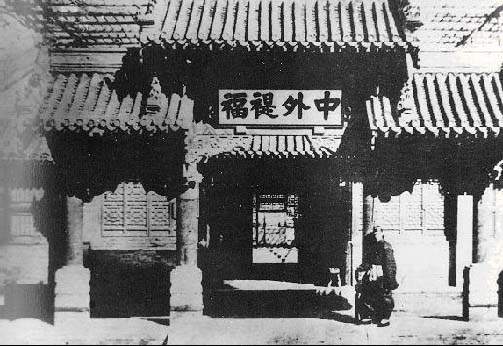 Photograph of the Zongli Yamen
Important Characters Of Late Qing Empire
Li Hongzhang: China's 19th Century Master Diplomat
Li Hongzhang was China's most powerful official during the twilight of the Qing Dynasty - a brilliant diplomat trapped between an ancient empire and an aggressive industrialized West.
As China's chief negotiator with foreign powers for nearly three decades, Li was:
The Diplomat: Negotiated dozens of treaties with Western powers and Japan while trying to preserve Chinese sovereignty against overwhelming odds.
The Modernizer: Established China's first modern industries, railroads, and military academies while facing fierce conservative opposition.
The Personality:
- Pragmatic to a fault - famously told conservatives: "We cannot fight; let's learn from them"
- Shrewd negotiator - Western diplomats complained he could outmaneuver them with delays and wordplay
- Culturally confident - maintained Chinese dress and customs while studying Western technology
- Sardonic wit - once told a British diplomat: "You're all so anxious to get to heaven; we Chinese prefer to live on earth"
To Westerners, Li was the face of China. To Chinese history, he remains controversial - either a patriot doing his best in impossible circumstances or the symbol of imperial China's humiliation.
 Photograph of Li Hongzhang.
Zuo Zongtang: China's Indomitable General
Zuo Zongtang was China's most formidable military commander during the late 19th century - the man who preserved China's western frontiers while his rival Li Hongzhang handled diplomacy in the east.
Career Highlights:
- Crushed the massive Taiping Rebellion that had claimed 20+ million lives
- Reconquered China's vast western regions (Xinjiang) from Russian influence and Muslim rebellions
- Established China's first modern arsenals and shipyards
The Personality:
- Famously stubborn - refused to retreat even when government funding was cut
- Pragmatically traditional - wore Chinese robes while building modern weapons
- Fiercely patriotic - when told China couldn't win a war with Russia, he responded: "I'll fight to the death anyway"
- Legendarily frugal - ate simple meals even as a top official (ironically, "General Tso's Chicken" in American restaurants is loosely named after him)
While Li Hongzhang negotiated with foreigners, Zuo fought to preserve China's territory. Their rivalry defined late Qing politics: Zuo representing stubborn resistance, Li representing pragmatic compromise. Together, they prevented China's complete colonization during its weakest century.
 Photograph of Zuo Zongtang.
Zeng Guofan: China's Reluctant Savior
Zeng Guofan (1811-1872) was arguably the most influential Chinese figure of the 19th century - a Confucian scholar who reluctantly became a military leader and saved the crumbling Qing Dynasty against all odds.
Historic Significance:
- Created China's first modern army from scratch during the devastating Taiping Rebellion (a civil war larger than America's Civil War)
- Mentored both Li Hongzhang and Zuo Zongtang, who would later defend China against foreign powers
- Pioneered early modernization efforts while maintaining Chinese cultural identity
The Personality:
- Morally strict - followed ancient Confucian disciplines so rigorously he once knelt for hours in the snow to reflect on personal failings
- Intellectually brilliant - one of China's top scholars before becoming a general
- Psychologically tormented - his diaries reveal constant self-doubt and ethical struggles about killing fellow Chinese
- Methodically determined - spent years building a disciplined army when others sought quick victories
Zeng embodied China's internal struggle between tradition and modernity. While Western imperialism threatened China from outside, he fought to preserve its moral core while adapting to a changing world. Virtually every modern Chinese leader since, regardless of ideology, has claimed inspiration from his balanced approach to modernization.
 Photograph of Zeng Guofan.
Yuan Shikai: The Cunning General Who Shaped Late Imperial China
Yuan Shikai (1859-1900s) was one of late Qing Dynasty China's most influential and controversial military leaders - a skillful modernizer with ruthless political instincts.
Rise to Power:
- Climbed from minor military officer to commander of China's elite Beiyang Army
- Pioneered Western military training while maintaining tight personal control
- Built China's most powerful patronage network through his loyal officers
The Korean Crucible:
Yuan's formative years were spent in Korea (1885-1894) as China's "Imperial Resident," where he:
- Orchestrated a coup that installed a pro-Chinese government
- Controlled Korean politics through military presence and palace intrigue
- Built modern Korean military units trained by Chinese officers
- Engaged in constant power struggles against Japanese influence
- Eventually lost control during the 1894 Sino-Japanese War when his modernization efforts proved insufficient
The Personality:
- Politically ruthless - eliminated rivals through intrigue rather than direct confrontation
- Cunningly adaptable - maintained relationships with both conservative and reform factions
- Personally charming - Western diplomats noted his unusual ability to connect across cultural barriers
- Ambitious beyond measure - always positioned himself for greater power
By 1900, Yuan had established himself as China's most powerful military figure, carefully balancing between tradition and modernization while pursuing his own advancement at every turn.
 Photograph of Yuan Shikai.
Emperor Guangxu: China's Tragic Reformer
Emperor Guangxu (1871-1898) was the 11th emperor of China's Qing Dynasty, ascending the throne at just four years old in 1875. Despite his imperial title, real power remained with his aunt, the formidable Empress Dowager Cixi, who ruled from behind the curtain.
As Guangxu matured, he grew increasingly sympathetic to the "Self-Strengthening Movement" (yangwu pai) - progressive officials who advocated adopting Western technology, military systems, and educational reforms while preserving Chinese cultural foundations. These reformers believed China needed modernization to survive in an era dominated by Western imperial powers.
In 1898, Guangxu briefly broke free from Cixi's control and launched the "Hundred Days' Reform," working with intellectuals like Kang Youwei to modernize China's government, military, and economy. Their ambitious reforms included:
- Establishing modern schools and universities
- Restructuring the imperial examination system
- Modernizing the military
- Promoting industrial development
However, these reforms threatened conservative interests. After just 103 days, Cixi orchestrated a palace coup, imprisoned Guangxu in his own palace, and executed many of his reformist allies. This dramatic failure marked the last significant attempt at comprehensive reform under the Qing Dynasty.
 Portrait of Emperor Guangxu.
Empress Dowager Cixi: China's "Old Buddha"
Empress Dowager Cixi (1835-1908) rose from a concubine to become China's ultimate power broker during the late Qing Dynasty. Court officials and servants addressed her as "Lao Foye" (Old Buddha), reflecting her godlike authority over imperial China for nearly five decades.
Though initially supporting limited modernization efforts by the Self-Strengthening Movement, Cixi remained deeply suspicious of Western influence. She reluctantly approved:
- Modern military arsenals
- Telegraph lines
- Foreign diplomatic missions
However, "Old Buddha" prioritized preserving imperial power over national development. She infamously embezzled navy funds to build a marble boat in her palace gardens and maintained rigid Confucian traditions at court.
Her most consequential decision came in 1898, when she crushed her nephew Emperor Guangxu's Hundred Days' Reform movement, imprisoning him and executing his progressive allies. This coup effectively ended China's last meaningful chance at comprehensive reform under imperial rule, cementing Cixi's legacy as a ruler who chose personal power over national transformation.
 Photograph of Empress Dowager Cixi.
Story Opening Narrations
Opening 1: The Golden Ticket: Becoming China's Top Scholar (No specific year).
Across the vast Qing Empire, millions of ambitious young men spent decades memorizing Confucian classics by candlelight, fingers calloused from endless writing practice, sacrificing youth and fortune for a slim chance at success. Most failed repeatedly, growing old in tattered scholar's robes.
Then imagine the unthinkable happens—you've achieved zhuangyuan, the Empire's #1 scholar.
Overnight, your life transforms. The Emperor himself honors you at the Forbidden City. Aristocratic families suddenly offer their daughters in marriage. Your name adorns the imperial scrolls. Most crucially, you leap directly into the highest echelons of government service—a commoner now helping rule an empire of 400 million souls.
Yet with this dazzling success comes the parade of desperate former competitors. Failed candidates who once studied beside you now approach with flattering smiles and trembling hands, begging for introductions, appointments, or mere scraps from your imperial feast—each hoping your astronomical rise might pull them from their academic purgatory.
Opening 2: Between Empire and Fury: A Qing Official's Dilemma (Post-1850).
You are a district magistrate in China's crumbling Qing Empire, where a new powder keg has just exploded on your doorstep—a "church case" (jiaoan).
Your ornate magistrate's hat suddenly feels impossibly heavy. Each path before you leads to disaster:
Side with your countrymen? The French gunboats already patrolling your coast will hear within days. The last official who failed to protect missionaries saw his city bombarded, territory seized, and crippling indemnities imposed on an already bankrupt empire.
Punish the villagers? You might wake tomorrow to find your own residence surrounded by thousands of outraged peasants, your name forever cursed as a "foreign devil's lackey." Such popular fury has overthrown dynasties before.
As you sit at your dark wood desk, brush hovering over blank judgment paper, both empire and ancestors seem to hold their breath. What will you write?
Opening 3: Trapped Between History's Pages: The Battle of Bali Bridge (1857).
September 21, 1860. You stand before Baliqiao (Eight Mile Bridge) outside Beijing, golden-threaded general's banner fluttering behind you. Thirty thousand Qing soldiers await your command—cavalry with their curved dadao swords, infantry clutching matchlock muskets unchanged since the 1700s.
Across the bridge looms a force barely 4,000 strong—yet your heart pounds with supernatural knowledge. These Anglo-French troops carry Enfield rifles firing six rounds per minute. Their artillery is rifled, not smoothbore. Their tactics are forged in European wars you've never studied.
History has already written tomorrow's headlines: your forces will be slaughtered in hours. Over 1,200 of your men will fall while the foreigners lose barely sixty. Emperor Xianfeng will flee his Summer Palace. The foreigners will soon burn China's crown jewel, the Yuanmingyuan, to ashes.
You alone possess this terrible vision of the future—a disaster waiting just hours away. The fate of the Dragon Throne rests in your hands.
What will you do with this forbidden knowledge?

Opening 4: The Sacking of Summer Palace (1860).
October 18, 1860. You stand before the gilded gates of Yuanmingyuan—the legendary "Garden of Perfect Brightness"—as commander of Her Majesty's expeditionary forces in China. The morning mist parts to reveal pavilions of jade and gold, man-made lakes spanned by marble bridges, and gardens that rival Versailles.
Your uniform still carries dust from the campaign. Just days ago, you received news that turned military discipline into cold fury: twenty British and French envoys, sent under white flag to negotiate peace, returned as mutilated corpses after weeks of torture in Qing dungeons.
Lord Elgin's orders arrived this morning, written in his aristocratic hand:
"The Imperial Summer Palace must pay the price for Chinese barbarity. No quarter. No hesitation. Let this serve as the Emperor's lesson in civilization."
Your men are already fanning out across the grounds—soldiers who've marched halfway around the world to find themselves amid treasures beyond imagination. Exquisite porcelain, jade carvings, and silk scrolls dating back dynasties. Some will find their way to British museums, others to private collections. Much will simply be destroyed.
Now, the torches will be lit. Within 48 hours, two centuries of imperial splendor will become ash and memory—China's Versailles erased from existence.
The order weighs in your hand. History awaits your command.
Opening 5: Heaven's General at the Crossroads (1861).
China burns. You stand atop a hastily built watchtower, golden banner of the Taiping Heavenly Kingdom fluttering above you. Just five years ago, Hong Xiuquan—a failed scholar who suffered feverish visions—declared himself Christ's younger brother on a divine mission to overthrow the Manchu Qing Dynasty. His radical message—equality, shared property, end to foot-binding, and destruction of Confucian hierarchy—ignited China's poorest into history's deadliest civil war.
Under your command, Taiping forces have captured half of China. Twenty million already lie dead. Cities that resisted have been put to the sword; those that surrendered now live under biblical law. Imperial forces retreated everywhere before your righteous fury.
Until now.
Through your spyglass, you observe a disciplined army unlike any imperial force you've faced. No longer the demoralized Qing troops you've scattered like leaves. These men move with purpose, their modern weapons gleaming. Their commander? Zeng Guofan—Confucian scholar turned brilliant general—who built this new "Xiang Army(Hunan Army)" from scratch, inspiring fanatical loyalty through shared provincial ties rather than loyalty to the distant Emperor.
The Heavenly Kingdom's fate may rest on your next decision. Heaven's younger prince awaits your strategy.
Opening 6: The Hollow Fleet: Yellow Sea (1895).
The fate of two empires hangs in the balance as your flagship cuts through the choppy Yellow Sea waves. You command the Beiyang Fleet—China's maritime pride with its German-built battleships and Armstrong guns that once made European admirals envious.
What began as a minor Korean rebellion has erupted into full-scale war between ancient China and modernizing Japan. Now Qing forces are collapsing in Pyongyang, desperately awaiting the supplies your ships escort.
On the bridge, naval telegraph operators report a chilling development—the Japanese Combined Fleet has appeared on the horizon. Western military attachés aboard expect an easy victory for your numerically superior force. London and Berlin betting odds favor China three-to-one.
Only you know the devastating truth: while impressive on paper, your ships haven't fired their main guns in years. Corruption has left powder stores damp, shells without fuses, and boilers struggling to maintain steam. Behind gleaming hulls lies a fleet that exists more in reputation than reality.
As Japanese smokestacks multiply across the horizon, you face a decision that will reshape Asia's balance of power for the next century.
Opening 7: The Fateful Negotiation: China's Darkest Hour (1895)
The year is 1895. The unthinkable has happened—the ancient Chinese Empire has been utterly defeated by Japan, a nation it once dismissed as a "dwarf kingdom." The First Sino-Japanese War stands as brutal proof that Japan's Meiji Restoration has succeeded while China's own modernization attempts have catastrophically failed.
You accompany Li Hongzhang, China's most powerful statesman, to the Japanese port of Shimonoseki for peace negotiations. The weight of four thousand years of civilization rests on your shoulders as you enter the negotiation chamber.
Across the table sit Japanese officials with unwavering demands: 200 million taels of silver in war reparations—a staggering sum that would bankrupt the treasury—plus the surrender of Taiwan and the strategic Liaodong Peninsula. This is not merely a treaty; it is the blueprint for China's dismemberment.
Foreign powers circle like vultures, ready to claim their own pieces of the weakened empire. The Japanese negotiators show no mercy, knowing they have transformed the balance of power in Asia forever.
In this moment of national crisis, can you find a way to salvage China's dignity and survival? Or will you witness the beginning of what history will call "the century of humiliation"?
Opening 8: The Boxer Uprising: China's Desperate Gamble
The year is 1899. China burns with rage as the Boxer Rebellion ignites across the land. What began as violent protests against Christian missionaries has transformed into something far more powerful—a movement that Empress Dowager Cixi now sees as her weapon against the foreigners who have carved up China like a melon.
You are the leader of the Boxers—the "Righteous and Harmonious Fists." Your followers believe their spiritual training makes them invulnerable to foreign bullets. They march under banners proclaiming "Support the Qing, Destroy the Foreign" and "Drive Out the Foreign Devils."
Your target: the Legation Quarter in Beijing, where diplomats and their families from eight foreign powers cower behind makeshift barricades. Your force numbers 100,000 strong, while the foreign defenders count fewer than 500.
The Empress Dowager has declared war. The foreigners are trapped. Their reinforcements are weeks away.
Can you storm Beijing, fulfill your sacred mission to purge China of the foreign presence, and change the course of history?
Opening 9: Besieged: The Last Stand in Beijing
In the summer of 1899, China erupted in chaos as the Boxer Rebellion ignited across the nation. What began as anti-Christian violence soon transformed into something more dangerous when Empress Dowager Cixi made a fateful decision: rather than suppress the rebels, she would harness their fury against all foreigners. In a stunning move that shocked the world, China declared war against eight global powers simultaneously.
You now stand as commander of the international forces in Beijing. Your troops are well-armed with modern weapons but critically outnumbered—fewer than 500 soldiers against an estimated 100,000 Boxers surrounding the city. The Boxers believe their martial arts rituals make them impervious to foreign bullets, and their battle cries echo throughout the ancient capital.
Can you coordinate your limited forces to hold Beijing until reinforcements navigate through hundreds of miles of hostile territory? The fate of every foreigner in the city rests on your decisions.